GET THE Exclusive discounts today!



How Many Types of Gear?
Discover the definitive list of gear types, including spur, helical, planetary, and worm gears. Learn about gear classification, applications, and how to choose the right gear for your project.
Jenny
12/22/20254 min read
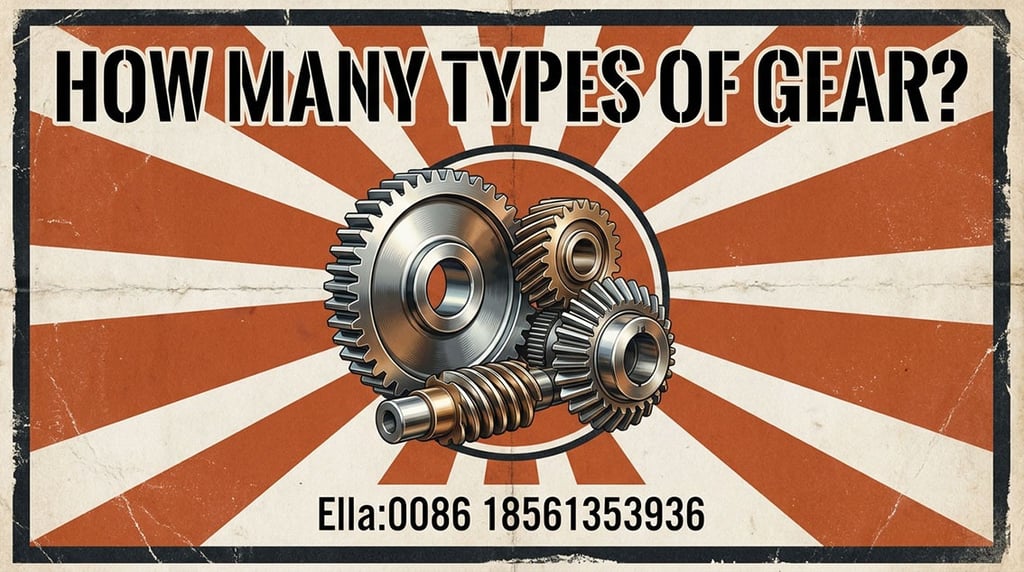
How Many Types of Gear? The Definitive Guide to Mechanical Gear Classification
In the world of mechanical engineering, gears are the silent heroes of motion. From the tiny ticking components of a luxury wristwatch to the massive planetary systems driving industrial mining equipment, gears are fundamental to power transmission. But for engineers and purchasers, a critical question often arises: How many types of gear are there, and which one is right for my application?
While there are dozens of specialized variations, most mechanical gears fall into several primary categories based on their design, tooth geometry, and shaft orientation. In this comprehensive guide, we will explore the intricate landscape of gear types, their unique characteristics, and the engineering principles that govern their selection.
1. Understanding Gear Classification: The Three Main Categories
Before diving into specific types, it is essential to understand that gears are primarily classified by the relationship between the axes of the shafts they connect. This is the most logical way to answer "how many types of gear" exist:
Parallel Shaft Gears: The shafts are parallel to each other.
Intersecting Shaft Gears: The shafts intersect at a certain point (usually 90 degrees).
Non-Parallel, Non-Intersecting (Skew) Shafts: The shafts cross each other but do not intersect in space.
2. Parallel Shaft Gears: The Workhorses of Industry
Parallel shaft gears are the most common. Because the shafts are parallel, these systems are relatively easy to manufacture and maintain.
Spur Gears
The spur gear is the simplest and most widely used type of gear. It features straight teeth cut parallel to the gear's axis.
Advantages: High transmission efficiency, simple design, and cost-effective production.
Disadvantages: They can be noisy at high speeds because the entire face of the tooth engages at once, creating a "clatter."
Applications: Clocks, washing machines, and low-speed industrial machinery.
Helical Gears
Helical gears are an evolution of spur gears. Their teeth are cut at an angle (the helix angle) to the axis.
Characteristics: The angled teeth engage gradually, making them much quieter and smoother than spur gears. They can also carry heavier loads.
The Challenge: Helical gears produce "axial thrust" (force along the shaft), which requires specialized bearings.
Applications: Automotive transmissions and high-speed industrial gearboxes.
Double Helical and Herringbone Gears
To solve the axial thrust problem of helical gears, engineers developed double helical gears. These feature two sets of helical teeth with opposite angles, which cancel out the thrust forces.
Herringbone Gears: A specific type of double helical gear where the two sets of teeth meet in the middle without a groove.
Applications: Heavy machinery, such as large pumps and marine propulsion systems where high torque and stability are required.
Internal Gears
Unlike standard gears where teeth are on the outside of a cylinder, internal gears have teeth cut into the inner surface of a ring. They usually mesh with a smaller external gear called a "pinion."
Benefit: They allow for a very compact design and provide high load capacity due to better tooth contact.
3. Intersecting Shaft Gears: Changing Direction
When power needs to be transmitted between shafts that meet at an angle, intersecting shaft gears are utilized.
Bevel Gears
Bevel gears are shaped like a truncated cone. They are primarily used to transmit power between shafts that intersect at 90 degrees, though other angles are possible. There are four main subtypes:
Straight Bevel Gears: The teeth are straight, similar to spur gears. They are simple but can be noisy.
Spiral Bevel Gears: The teeth are curved, allowing for smoother and quieter operation at high speeds.
Zerol Bevel Gears: A hybrid between straight and spiral, where the teeth are curved but have a zero helix angle.
Miter Gears: Bevel gears with a 1:1 ratio, used purely to change direction without changing speed.
4. Non-Parallel, Non-Intersecting Shaft Gears: Complex Motion
These gears are used for specialized applications where shafts cross at different planes.
Worm Gears
A worm gear system consists of a "worm" (a screw-like gear) and a "worm wheel."
Key Feature: They provide massive speed reduction in a very small space (e.g., 60:1 ratio).
Self-Locking: Most worm gears are self-locking, meaning the worm can turn the wheel, but the wheel cannot turn the worm. This is a vital safety feature for elevators and conveyors.
Efficiency: Because they rely on sliding friction, they are less efficient and generate more heat than spur or helical gears.
Hypoid Gears
Commonly seen in automotive rear-axle differentials, hypoid gears look like spiral bevel gears but the shafts do not intersect. This allows the drive shaft to be positioned lower, which is ideal for lowering the center of gravity in vehicles.
5. Specialized Gear Systems
Rack and Pinion
This system converts rotational motion into linear motion. A circular gear (the pinion) meshes with a flat, toothed bar (the rack).
Applications: Steering systems in cars and stairlifts.
Planetary Gear Systems (Epicyclic)
A planetary gear set consists of a central "sun" gear, several "planet" gears, and an outer "ring" gear.
Why use them? They offer incredible torque density and multiple gear ratios in a compact package.
Applications: Automatic transmissions, electric vehicle motors, and robotics.
6. Gear Materials and Manufacturing: The Customization Edge
As a leader in custom gear manufacturing, we know that "type" is only half the story. The material and heat treatment are what determine a gear’s lifespan.
Steel Alloys (4140, 8620): Used for high-strength industrial applications.
Stainless Steel: For food processing or corrosive environments.
Plastics (Nylon, POM): For quiet, lubrication-free operation in consumer electronics.
Precision Grinding: High-performance gears require AGMA 12-15 precision levels to ensure minimal vibration.
7. How to Choose the Right Gear Type?
Selecting the perfect gear depends on four critical factors:
Load and Torque: High-torque applications often require helical or planetary systems.
Speed: High-speed requirements favor spiral bevel or helical designs for noise reduction.
Efficiency: If energy conservation is paramount, avoid worm gears due to sliding friction.
Spatial Constraints: Internal and planetary gears are best for tight spaces.
Conclusion
So, how many types of gear are there? While the variations are nearly endless, the core types—spur, helical, bevel, worm, and planetary—form the foundation of modern mechanical design. Understanding the nuances of each type is the first step toward optimizing your machinery for performance and longevity.
At Qingdao Novi Machinery, we specialize in taking these standard types and customizing them to your exact specifications. Whether you need a high-precision spur gear for robotics or a heavy-duty herringbone gear for industrial mining, our engineering team is here to help.
Contact us today for a custom gear quote!
Looking for a reliable gear supplier for your project?
Send us your drawings or technical requirements, and our engineering team will provide a professional gear solution.
Address:Huangdao district,Qingdao city,Shandong province,China
© 2026. All rights reserved.
Quick Link