GET THE Exclusive discounts today!



How Many Types of Gear Box? The Ultimate Industrial Guide (2026)
Looking for the right gearbox? Read our comprehensive guide on the different types of gear box, including helical, planetary, worm, and bevel reducers. Expert tips on selection and efficiency.
8/19/20254 min read
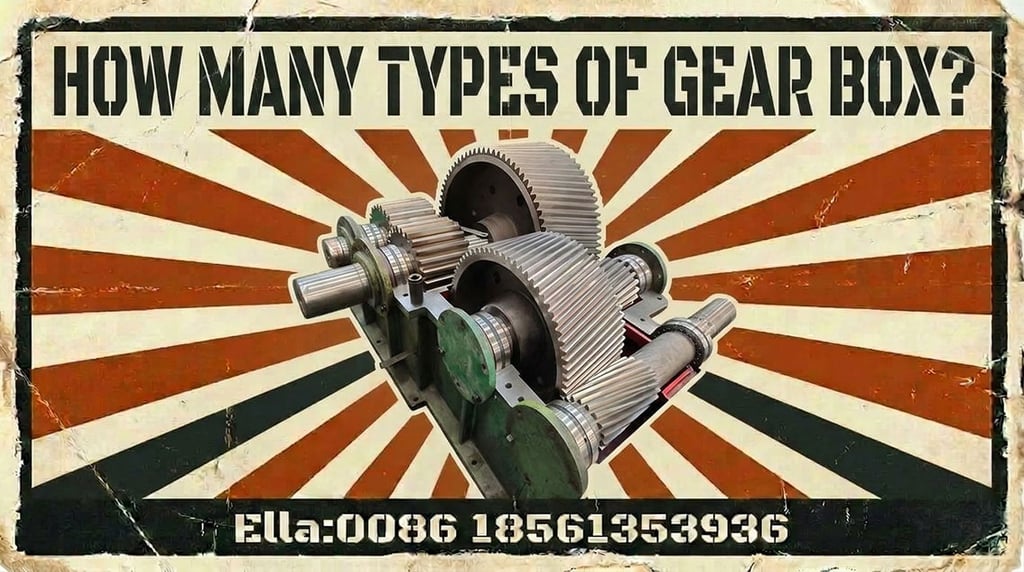
How Many Types of Gear Box? A Comprehensive Guide to Industrial Speed Reducers
In the complex ecosystem of mechanical power transmission, the gearbox—often referred to as a speed reducer—is the heart of the system. Its primary role is simple yet critical: to adjust the speed and torque between a prime mover (like an electric motor) and a driven load. However, the sheer variety of gearboxes available today can be overwhelming for even experienced engineers.
If you are asking, "How many types of gear box are there?", the answer depends on how you classify them—by gear arrangement, shaft orientation, or application. In this definitive guide, we will break down the most essential gearbox types used in modern industry, exploring their mechanics, advantages, and ideal use cases.
1. What is a Gearbox and Why is it Necessary?
Before exploring the types, we must understand the "Why." Most electric motors run at high speeds (e.g., 1750 RPM) with relatively low torque. Most industrial applications, such as conveyors, mixers, or crushers, require low speeds but massive torque.
The gearbox bridges this gap. By using different gear ratios, it reduces the output speed while simultaneously multiplying the output torque. Additionally, it can change the direction of motion (e.g., from a horizontal motor to a vertical shaft).
2. Classification by Gear Arrangement
The most common way to answer "how many types of gear box" is to look at the internal gear configuration.
A. Helical Gearboxes
The helical gearbox is perhaps the most popular choice in heavy-duty industrial settings. Unlike spur gears, helical gears have teeth cut at an angle.
Key Characteristics: As the gears turn, the teeth engage gradually. This results in smoother, quieter operation and the ability to handle much higher loads than spur gearboxes.
Efficiency: Typically 94% to 98% per stage.
Best For: Continuous high-speed applications like water treatment, food processing, and paper mills.
B. Planetary Gearboxes (Epicyclic)
Named for their resemblance to a solar system, these consist of a central "Sun" gear, "Planet" gears, and an outer "Ring" gear.
Key Characteristics: They offer the highest torque density of any gearbox. Because the load is shared among multiple planet gears, the system is incredibly compact.
Precision: Often used where low backlash (minimal play between gears) is required.
Best For: Robotics, 3D printing, wind turbines, and electric vehicles.
C. Worm Gearboxes
A worm gearbox uses a screw-like "worm" to drive a "worm wheel."
Key Characteristics: They offer massive reduction ratios in a single stage (up to 100:1). Their most unique feature is self-locking capability—the output shaft cannot turn the input shaft, acting as a natural brake.
Trade-off: They are the least efficient (often 50% to 90%) due to high sliding friction.
Best For: Elevators, conveyor belts, and material handling where safety braking is essential.
D. Bevel Helical Gearboxes
These combine bevel gears (for a 90-degree turn) with helical gears (for efficiency).
Key Characteristics: They allow the motor to be mounted at a right angle to the driven shaft, saving significant floor space.
Best For: Quarrying, mining, and heavy-duty agitation.
3. Classification by Shaft Orientation
When designing a machine, space is often the biggest constraint. Gearboxes are categorized by how the input and output shafts relate to each other:
In-Line Gearboxes: The input and output shafts share the same axis (common in planetary and some helical designs).
Parallel Shaft Gearboxes: The shafts are offset but parallel (common in standard helical gearboxes).
Right-Angle Gearboxes: The output shaft is at 90 degrees to the input (common in worm and bevel designs).
Shaft-Mounted Gearboxes: These are mounted directly onto the driven shaft, eliminating the need for a coupling and a foundation.
4. Technical Deep Dive: Efficiency vs. Torque
To truly understand how many types of gearbox you need to consider, you must look at the physics:
High Efficiency (Helical/Planetary): If your goal is to reduce energy costs and heat generation, helical or planetary gearboxes are the gold standard. They lose very little energy to friction.
High Torque, Low Speed (Worm): If you need to move a massive weight very slowly and budget is a concern, the worm gearbox is the go-to solution, despite its lower efficiency.
Dynamic Response (Planetary): For applications requiring frequent starts, stops, and reversals, the low inertia of planetary systems provides the best dynamic performance.
5. Materials and Durability: The Manufacturer's Perspective
As a specialist in custom gearbox manufacturing, we emphasize that the "type" of gearbox is only as good as its components.
Housing: Usually made of high-quality cast iron for vibration dampening or aluminum for weight-sensitive applications.
Gears: Case-hardened steel (e.g., 20CrMnTi) ensures the teeth can withstand high surface pressure without wearing down.
Bearings: High-capacity tapered roller bearings are often used to handle the axial and radial loads generated by helical gears.
Seals: Viton or Nitrile seals are critical to preventing oil leaks, which are the #1 cause of gearbox failure.
6. Common Industrial Applications
Food & Beverage: Requires stainless steel, wash-down duty gearboxes (usually helical or worm).
Mining & Construction: Needs heavy-duty bevel helical gearboxes that can withstand shock loads and dusty environments.
Renewable Energy: Wind turbines rely on multi-stage planetary gearboxes to convert slow blade rotation into high-speed generator rotation.
Aerospace: High-precision, lightweight planetary gearboxes are used in flight control actuators.
7. How to Choose the Right Gearbox? (The Selection Checklist)
When choosing between the many types of gear box, use this checklist:
Required Torque: What is the maximum torque the application will demand?
Input/Output Speed: What is the motor speed and the desired output speed?
Service Factor: Will the gearbox run 24/7? Does it face shock loads? (A service factor of 1.5 or 2.0 might be needed).
Mounting Position: Horizontal, vertical, or wall-mounted? This affects lubrication and cooling.
Environmental Conditions: Is it a corrosive environment? Extreme heat or cold?
8. The Future of Gearbox Technology
The industry is moving toward Smart Gearboxes. These are equipped with vibration and temperature sensors that feed data into the cloud. This allows for Predictive Maintenance—fixing the gearbox before it breaks, saving companies thousands in downtime.
Furthermore, the rise of "Vibe Marketing" and rapid prototyping allows us to deliver custom gearbox solutions faster than ever before. We no longer just provide a "type"; we provide a precision-engineered answer to a specific problem.
Conclusion
Determining how many types of gear box are relevant to your business depends on your specific performance requirements. Whether it is the quiet efficiency of a helical gearbox, the space-saving power of a planetary system, or the cost-effective torque of a worm drive, each has its place in the world of engineering.
At Qingdao Novi Machinery, we don't just manufacture gearboxes; we engineer growth. Our team of experts is ready to help you navigate these types and select the perfect speed reducer for your next project.
Get a Professional Gearbox Consultation Today!
Looking for a reliable gear supplier for your project?
Send us your drawings or technical requirements, and our engineering team will provide a professional gear solution.
Address:Huangdao district,Qingdao city,Shandong province,China
© 2026. All rights reserved.
Quick Link