GET THE Exclusive discounts today!



How to Calculate Gear Ratio?The Engineering Mathematics Guide
Master the mathematics of power transmission. Learn the formulas to calculate gear ratio for torque multiplication, RPM reduction, compound systems, and planetary gears.
Sam
11/11/20255 min read
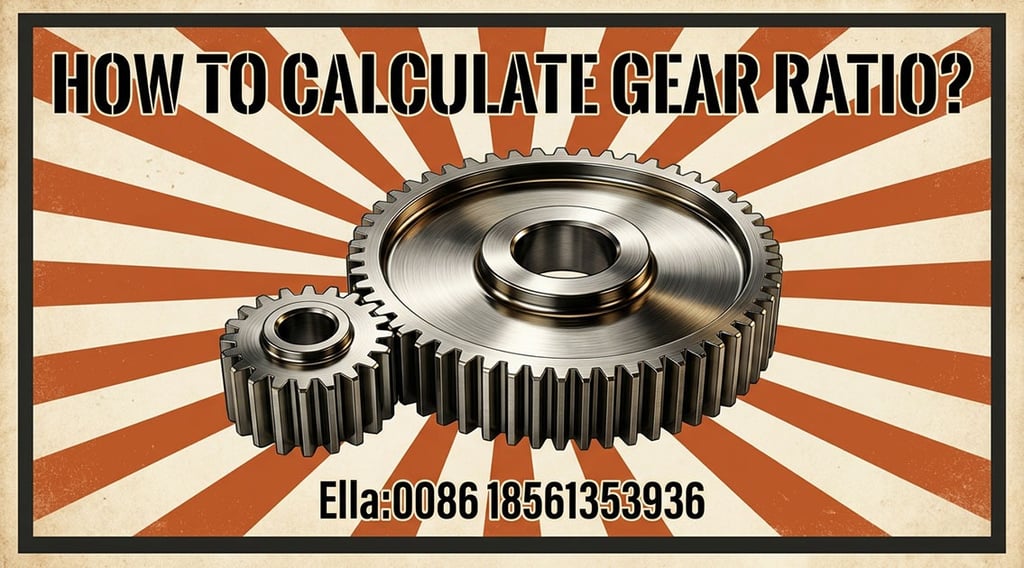

How to Calculate Gear Ratio? The Mathematical Guide to Engineering Power Transmission
In the domain of mechanical design, the ability to calculate gear ratios is the bridge between a theoretical concept and a functional machine. While many people understand the basic concept of gears, the professional engineer must master the mathematical intricacies that govern speed, torque, and efficiency.
If you are asking, "How to calculate gear ratio?", you are likely navigating the complexities of power transmission. Calculating the ratio is not merely about counting teeth; it is about managing the laws of physics to ensure your system performs with precision. In this definitive guide, we will explore the mathematical foundations of gearing, provide the formulas for complex multi-stage systems, and explain how to account for real-world variables like mechanical efficiency.
1. The Mathematical Foundation: The Basic Ratio Formula
At its core, the gear ratio (RR) is a mathematical expression of the relationship between two or more meshing gears. The most fundamental formula used by engineers is based on the number of teeth (NN) on the gears.
The formula is: Gear Ratio (R) = Noutput / Ninput
In this equation:
Noutput (Driven Gear): The number of teeth on the gear being moved.
Ninput (Driver Gear): The number of teeth on the gear providing the power.
For example, if a motor (input) has a 12-tooth gear and it drives a 48-tooth gear on a conveyor belt (output), the calculation is 48 divided by 12, resulting in a 4:1 ratio. This means the input must rotate four times to produce one rotation of the output.
2. Calculating the Relationship Between Speed and Ratio
In engineering, we often calculate the gear ratio based on the desired Angular Velocity (ωω) or RPM. The relationship between the gear ratio and speed is inversely proportional. As the gear ratio increases, the output speed decreases.
The formula using RPM is: Gear Ratio (R) = RPMinput / RPMoutput
If you have a motor spinning at 1,800 RPM and you need your output shaft to rotate at exactly 90 RPM, you calculate the required ratio by dividing 1,800 by 90. The result is 20, meaning you need a 20:1 gear ratio to achieve your target speed. This calculation is the starting point for selecting the correct gearbox for any automated system.
3. The Mathematics of Torque Multiplication
The primary reason we calculate gear ratios in industrial settings is to manipulate Torque (T). Unlike speed, the relationship between torque and the gear ratio is directly proportional.
The theoretical formula for output torque is: Toutput = Tinput * Gear Ratio (R)
If your motor produces 10 Newton-meters (Nm) of torque and you have a 10:1 gear ratio, the theoretical output torque is 100 Nm. This "Mechanical Advantage" allows small motors to move massive loads. However, as an engineer, you must remember that this is the theoretical maximum. In the real world, we must account for the energy lost during the transmission process.
4. Accounting for Mechanical Efficiency (η)
No mechanical system is 100% efficient. Friction between the teeth, heat generation, and bearing resistance all consume energy. Therefore, to calculate the Actual Output Torque, you must include the Efficiency Factor (η).
The professional formula is: Toutput = (Tinput*R)*η
Efficiency varies by gear type:
Spur/Helical Gears: Typically 95% to 98% per stage (η= 0.95 - 0.98).
Worm Gears: Can vary from 50% to 90% (η= 0.5 - 0.9) depending on the ratio.
If you have a 10:1 ratio with a 10 Nm input, but you are using a worm gear with 70% efficiency, your actual torque is (10 10) 0.70, which equals 70 Nm, not 100 Nm. Calculating with efficiency is what prevents system failure and motor burnout.
5. Calculating Ratios for Multi-Stage Compound Systems
When a single pair of gears cannot reach the desired ratio—for example, if you need a 100:1 reduction—you must use a Compound Gear Train. Calculating the total ratio for a multi-stage system involves the "Product of the Stages."
If you have a three-stage gearbox:
Stage 1 Ratio (R1): 4:1
Stage 2 Ratio (R2): 5:1
Stage 3 Ratio (R3): 5:1
The Total Gear Ratio (Rtotal) is calculated as: Rtotal= R1*R2*R3
In this example, 4*5 *5 = 100. Therefore, the total ratio is 100:1. When calculating compound systems, it is vital to keep the input and output gears of each stage clearly defined to avoid mathematical errors that could lead to an incorrect final ratio.
6. Mathematical Precision: The Hunting Tooth Frequency
In high-end gear manufacturing, we use mathematics to extend the life of the gear. If you calculate a perfectly even ratio like 4:1 (using 12 and 48 teeth), the same teeth will meet each other every four rotations. If there is a tiny imperfection in one tooth, it will hit the same spot on the mating gear repeatedly, leading to rapid wear.
Engineers often calculate a "Non-Integer" or "Hunting Tooth" ratio. For example, using a 13-tooth pinion and a 49-tooth gear creates a 3.769:1 ratio. Mathematically, this ensures that every tooth on the pinion will eventually meet every tooth on the gear before the cycle repeats. This "randomization" through prime-number mathematics significantly increases the lifespan of the gear set.
7. The Complexity of Planetary Gear Calculations
Planetary (epicyclic) gears are the most mathematically complex to calculate because they have three possible inputs/outputs: the Sun gear (S), the Ring gear (A), and the Planet Carrier (C).
The most common formula, where the Ring gear is held stationary, is: Ratio (R) = 1 + (NRing/NSun)
However, if the Sun gear is held stationary and the Ring is the input, the formula changes to: Ratio (R) = 1 + (NSun/NRing)
The ability to calculate these different permutations is what allows engineers to design multi-speed automatic transmissions and high-torque robotic actuators. Each configuration yields a different mechanical advantage and rotational direction.
8. Working Backwards: From Performance to Design
In a professional setting, we often start with the Desired Output and work backwards to find the required ratio and motor specifications.
Step 1: Calculate Required Torque. If you need to lift a 100 kg load on a 0.2 m radius drum, you need approximately 196 Nm of torque.
Step 2: Choose a Motor. If your preferred motor produces 20 Nm of torque.
Step 3: Calculate Required Ratio. Dividing 196 Nm by 20 Nm gives a required ratio of 9.8:1.
Step 4: Factor in Efficiency. If the gearbox is 90% efficient, you divide the required ratio by the efficiency (9.8 / 0.9), which means you actually need an 11:1 ratio to be safe.
This backward calculation ensures that you don't over-specify (wasting money) or under-specify (causing system failure) your gear components.
9. Conclusion: Mastering the Mathematics of Motion
So, how to calculate gear ratio? It is a journey from the simple division of teeth to the complex integration of efficiency, angular velocity, and torque. Understanding these formulas is the difference between a "hobbyist" approach and "professional" engineering.
The gear ratio is the lever of the modern world. By mastering its calculation, you gain control over the forces of nature, allowing you to move mountains with the power of a single motor. Whether you are designing a high-speed precision instrument or a heavy-duty industrial crusher, the mathematics remains the same.
At Qingdao Novi Machinery, we specialize in the precision calculation and manufacturing of custom gear solutions. Our engineering team utilizes advanced software to calculate not just ratios, but the optimal tooth profiles, load distributions, and efficiency factors for your specific application.
Are you ready to move from theory to production? Contact our engineering team today for a technical consultation on your next gearing project!
Looking for a reliable gear supplier for your project?
Send us your drawings or technical requirements, and our engineering team will provide a professional gear solution.
Address:Huangdao district,Qingdao city,Shandong province,China
© 2026. All rights reserved.
Quick Link