GET THE Exclusive discounts today!



What is a Helical Gear? The Ultimate Guide to High-Speed Gearing
What is a helical gear and why is it quieter than a spur gear? Learn about helix angles, axial thrust, double helical gears, and high-load industrial applications in our expert guide.
Sam
6/10/20256 min read
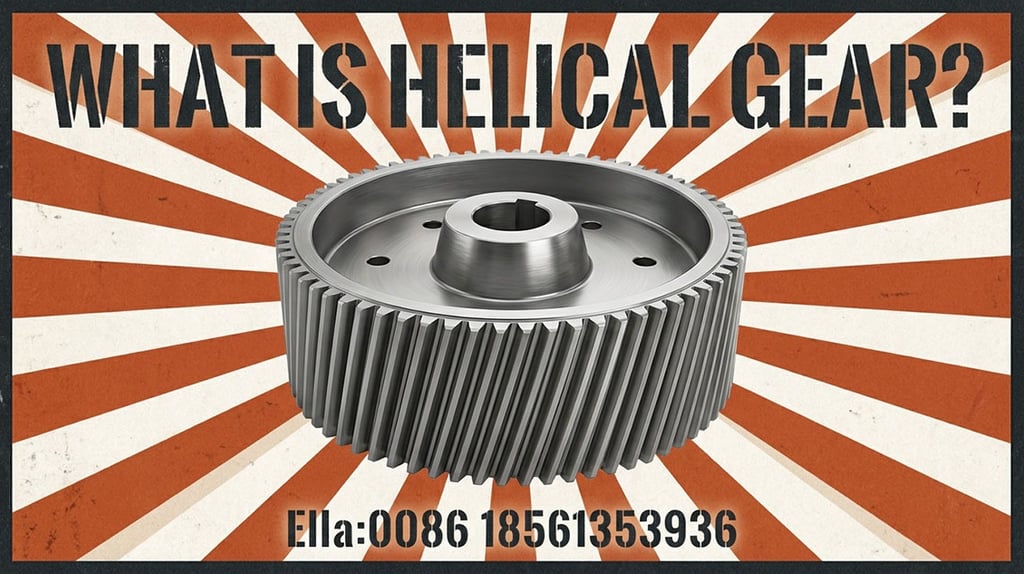
What is a Helical Gear? The Professional Guide to High-Performance Transmission
In the evolution of mechanical engineering, the quest for smoother, quieter, and more powerful machinery led to one of the most significant refinements in gear design: the helical gear. While the spur gear served the Industrial Revolution well, the demands of modern high-speed automotive engines, aerospace actuators, and heavy industrial gearboxes required something more sophisticated.
If you are asking, "What is a helical gear?", you are exploring a component that represents the pinnacle of parallel-shaft power transmission. By simply angling the teeth, engineers unlocked a world of increased load capacity and silent operation. In this definitive guide, we will explore the complex geometry, the critical importance of the helix angle, and the specialized applications that make helical gears the preferred choice for high-performance engineering.
1. Defining the Helical Gear: The Refined Cousin of the Spur Gear
At its most basic level, a helical gear is a cylindrical gear with teeth that are cut at an angle to the axis of rotation. This is the fundamental difference between a helical gear and a spur gear. Where spur gear teeth are straight and parallel to the shaft, helical gear teeth wrap around the cylinder in a path that resembles a helix—the same shape found in a screw thread or a DNA strand.
This angled orientation is not just a visual choice; it completely changes the physics of how the gears interact. When two helical gears mesh, they are typically mounted on parallel shafts, although they can also be configured for crossed (non-parallel) shafts. The result is a transmission system that is inherently more robust and significantly more refined than its straight-toothed counterparts.
2. The Science of Gradual Engagement: Why Helical is Quieter
The primary reason engineers choose helical gears is for noise reduction. But to understand "what is a helical gear," one must understand the mechanics of engagement.
In a spur gear, the entire face of the tooth engages at once. This creates a "clatter" or a "hammering" effect, especially at high speeds, as each tooth strikes its mate. This impact generates noise and vibration, which can lead to fatigue in the metal and a shorter lifespan for the machinery.
In a helical gear, the engagement is gradual. The contact starts at one end of the tooth and progresses smoothly across the face as the gear rotates. At any given moment, multiple teeth are in the process of engaging and disengaging. This continuous, rolling contact eliminates the "impact" found in spur gears. The result is a silent, fluid transfer of power that remains stable even at rotational speeds exceeding 10,000 RPM.
3. The Helix Angle: The Heart of the Design
The most critical parameter of a helical gear is the helix angle. This is the angle between the tooth trace and the axis of the gear. If the angle is zero, you have a spur gear. As the angle increases, the characteristics of the gear change.
Typically, industrial helical gears use a helix angle between 15 and 30 degrees. A higher angle provides even smoother operation and higher load capacity because it increases the "overlap ratio"—meaning more tooth surface area is in contact at once. However, a higher angle also increases a specific engineering challenge: axial thrust.
Because the teeth are angled, the force of the mesh is split into two components. One part turns the shaft (rotational force), but the other part tries to push the gear along the shaft (axial force). Engineers must account for this thrust by using specialized "thrust bearings" or by utilizing a more complex design known as the double helical gear.
4. Understanding Handedness: Left-Hand vs. Right-Hand Gears
Unlike spur gears, which are interchangeable, helical gears have "handedness." To mesh on parallel shafts, you must pair a left-hand helical gear with a right-hand helical gear.
You can determine the hand by looking at the teeth: if they lean toward the right as they move away from you, it is a right-hand gear; if they lean toward the left, it is a left-hand gear. If you try to mesh two gears of the same hand on parallel shafts, they will not fit. However, if you are designing a crossed-shaft system (where the shafts are at an angle to each other), you might actually use two gears of the same hand. This versatility is another reason why the helical gear is such a vital tool in the engineer's toolkit.
5. Solving the Thrust Problem: Double Helical and Herringbone Gears
As mentioned, the axial thrust produced by a single helical gear can be a disadvantage. For extremely heavy-duty applications—such as marine propulsion or large-scale pumping—the force trying to slide the gear along the shaft is too great for standard bearings to handle.
The solution is the double helical gear. This design features two sets of helical teeth cut side-by-side with opposite angles (one left-hand and one right-hand). As the gear turns, the thrust produced by one side is perfectly cancelled out by the thrust produced by the other.
A famous variation of this is the Herringbone gear, where the two helical tracks meet in the middle without a groove between them. This creates a "V" shape. While these are difficult and expensive to manufacture, they represent the ultimate in high-torque, stable, and thrust-free power transmission. In fact, the famous automotive brand Citroën uses the double helical shape as its corporate logo to honor the founder's history in gear manufacturing.
6. Helical Gear vs. Spur Gear: The Professional Comparison
When a client asks our engineering team for a recommendation, we look at several factors.
First is load capacity. Because helical gears have angled teeth, the teeth are actually longer than the width of the gear itself. This increased surface area means a helical gear can carry significantly more torque than a spur gear of the same size. If your design has space constraints but high power requirements, helical is the answer.
Second is speed. At low speeds, the benefits of helical gears might not outweigh their higher cost. But as speeds increase, the vibration in spur gears becomes a destructive force. For any application involving high-speed motors, helical gears are mandatory for longevity.
Third is cost and complexity. Helical gears require more complex CNC programming and specialized hobbing tools. They also require more expensive bearings to handle axial thrust. Therefore, they are an investment in quality and performance rather than a budget-first choice.
7. Critical Industrial Applications
Where will you find helical gears in the real world?
Automotive Transmissions: Almost every manual and automatic car uses helical gears for its forward speeds to ensure the cabin remains quiet and the gear shifts are smooth.
Renewable Energy: Wind turbines use massive helical gearboxes to convert the slow, high-torque rotation of the blades into the high-speed rotation required by the generator.
Industrial Mixers and Agitators: The smooth power delivery of helical gears prevents "surges" in the mixing process, ensuring a consistent product.
Heavy Lifting: Cranes and hoists utilize the high load capacity of helical sets to lift tons of material safely and quietly.
High-End Robotics: Precision helical gears are used where "backlash" must be minimized and motion must be fluid.
8. Manufacturing and Quality Control: The Precision Edge
At Qingdao Novi Machinery, we understand that a helical gear is only as good as its finish. Because the teeth are angled, the "lead error" (the deviation from the perfect helix path) is a major concern.
Precision Hobbing: We use synchronized CNC hobbing machines that can maintain perfect alignment between the rotation of the gear blank and the movement of the cutting tool.
Heat Treatment: Helical gears are often case-hardened to increase surface durability. However, heat treatment can cause slight distortion in the angled teeth.
Profile Grinding: To achieve the highest quality (AGMA 12 or higher), we perform precision tooth grinding after heat treatment. This ensures the involute profile and the helix angle are perfect to within microns, resulting in a gear that is virtually silent.
9. Conclusion: Why Choose Helical Gears for Your Project?
So, what is a helical gear? It is the professional's choice for power transmission. It is a component that balances the brute strength of increased surface area with the sophisticated silence of gradual engagement. While they require more careful design and more robust bearing support, the rewards are a machine that runs smoother, lasts longer, and operates at a level of refinement that spur gears simply cannot match.
Whether you are looking to reduce the noise in a consumer product or increase the torque capacity of an industrial gearbox, understanding the nuances of helical gearing is the first step toward a superior mechanical solution.
At Qingdao Novi Machinery, we specialize in the engineering and manufacturing of custom helical gears tailored to your specific speed, load, and environment requirements. Our team is ready to help you navigate the complexities of helix angles and thrust management to deliver the perfect gear for your success.
Ready to upgrade your transmission system? Contact our engineering team for a custom helical gear consultation today!
Looking for a reliable gear supplier for your project?
Send us your drawings or technical requirements, and our engineering team will provide a professional gear solution.
Address:Huangdao district,Qingdao city,Shandong province,China
© 2026. All rights reserved.
Quick Link