GET THE Exclusive discounts today!



What is a Pinion Gear? The Ultimate Guide to the Driving Gear
What is a pinion gear and what does it do? Discover the function of pinion gears in differentials, steering, and industrial machinery. Learn about materials, wear, and design.
Jenny
5/15/20256 min read
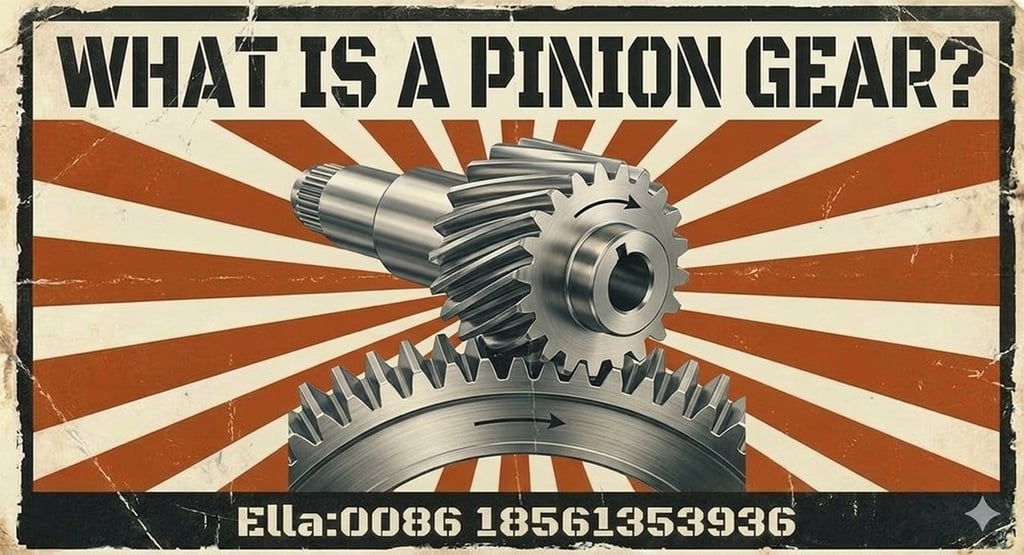

What is a Pinion Gear? The Professional Guide to the Driving Force of Gearing
In any mechanical system that utilizes gears to transmit power, there is almost always a hierarchy of size and speed. While we often speak of "gear sets" as a single unit, the individual components within those sets have distinct names and specialized roles. Perhaps the most critical, yet frequently misunderstood, component is the pinion gear.
If you are asking, "What is a pinion gear?", you are looking at the heart of the mechanical advantage. Whether it is the tiny gear on the end of an electric motor or the robust component at the front of a vehicle's differential, the pinion is the "small but mighty" partner in the gearing relationship. In this definitive guide, we will explore the definition, unique design challenges, and diverse industrial applications that make the pinion gear the unsung hero of power transmission.
1. Defining the Pinion Gear: The Smaller Partner
At its most fundamental level, a pinion gear is the smaller of two meshing gears in a gear set. When two gears of unequal size work together, the smaller one is termed the pinion, and the larger one is typically called the "gear," "wheel," or "ring gear."
The pinion gear is almost always the driving gear—the component that receives power directly from the motor or engine and transmits it to the rest of the system. Because it is smaller, it must rotate faster than its larger partner. This relationship is what creates speed reduction and torque multiplication, which are the primary goals of most mechanical transmissions.
2. The Functional Role of the Pinion in a Gear Set
The primary role of the pinion gear is to act as the primary input for motion. Because it is the "input," it bears the brunt of the initial force. There are three main functional transformations a pinion gear facilitates:
First, it enables Speed Reduction. In most industrial applications, motors spin at very high speeds (e.g., 1,800 RPM), which would be too fast for a conveyor belt or a mixer. By using a small pinion to drive a large gear, the speed is reduced to a manageable level.
Second, it facilitates Torque Multiplication. As speed is sacrificed through the pinion, torque (rotational force) is gained. This allows a relatively small motor to move a massive load. The pinion is the "lever" that makes this mechanical advantage possible.
Third, in specialized configurations like a Rack and Pinion, the pinion gear is responsible for converting rotational motion into linear (straight-line) motion. As the pinion turns, its teeth push against a flat, toothed bar (the rack), moving it left or right.
3. The Engineering Challenge: Why Pinions are Difficult to Design
From a manufacturing perspective, the pinion gear is often more difficult to engineer than its larger counterpart. This is due to several physical constraints that only apply to smaller gears.
One major challenge is Tooth Undercutting. When a pinion has a very small number of teeth (usually fewer than 12 or 17, depending on the pressure angle), the standard manufacturing process can "undercut" the root of the tooth. This removes metal from the base of the tooth, significantly weakening it and making it prone to snapping under load. Engineers must use specialized "profile shifting" or "long-addendum" designs to ensure the pinion teeth remain strong despite their small size.
Another challenge is Fatigue and Wear. If you have a gear set with a 10:1 ratio, the pinion gear rotates ten times for every single rotation of the larger gear. This means each individual tooth on the pinion experience ten times as much stress and contact as the teeth on the larger gear. Consequently, the pinion gear is almost always the first component in a system to wear out.
4. Types of Pinion Gear Configurations
The term "pinion" describes a role and size, rather than a specific shape. Therefore, pinions can come in many different geometries:
Spur Pinions: These are the most common. They feature straight teeth cut parallel to the shaft. They are highly efficient and easy to manufacture, often found in small electronics and simple industrial drives.
Helical Pinions: The teeth are cut at an angle. This allows for smoother and quieter engagement. Helical pinions are the standard in automotive transmissions and high-speed industrial gearboxes where noise reduction is a priority.
Bevel Pinions: These are cone-shaped and used to transmit power between intersecting shafts (usually at 90 degrees). The bevel pinion is a critical part of a vehicle's differential, where it drives the large "ring gear" to turn the wheels.
Planetary Pinions: In a planetary gear system, the "planets" are small pinion gears that rotate around a central "sun" gear. These are used when extreme torque density is required in a very compact space.
5. Critical Applications: Where Pinions Move the World
Pinion gears are ubiquitous across dozens of industries, each utilizing the pinion's unique properties to solve specific mechanical problems.
Automotive Steering and Differentials
The most famous application is the Rack and Pinion steering. When you turn your steering wheel, you are turning a pinion gear at the base of the steering column. This gear moves the rack, which in turn pivots the wheels of the car. In the vehicle's rear axle, the Differential Pinion takes the power from the driveshaft and turns it 90 degrees to drive the wheels, allowing them to rotate at different speeds during a turn.
Industrial Machinery and Conveyors
In factory settings, small pinion gears are often mounted directly onto electric motors. These drive large gears on conveyor drums or mixing vats. Because the pinion is the primary wear point, industrial maintenance teams often keep spare pinions on hand to ensure that a worn gear doesn't cause a total system shutdown.
Construction and Elevators
Many heavy-duty construction hoists and elevators utilize a rack and pinion system. The pinion is attached to the motor on the elevator car itself, and it "climbs" up a long vertical rack attached to the building. This is safer and more reliable for tall structures than traditional cable-and-pulley systems.
Robotics and Precision Actuators
In the world of robotics, precision is everything. Small, high-accuracy pinion gears are used in robotic joints. These pinions must be manufactured with "zero-backlash" tolerances to ensure that the robot's movements are perfectly smooth and repeatable.
6. Materials and Hardening: The Secret to Pinion Longevity
Because the pinion gear rotates more frequently and carries more stress per tooth than any other gear in the system, material selection is paramount. A pinion made of low-quality steel will fail within weeks in a high-torque environment.
At Qingdao Novi Machinery, we typically recommend high-strength alloy steels like 4140 or 8620 for pinion manufacturing. However, the material is only half the story. The heat treatment process is what gives the pinion its edge.
Case Hardening (Carburizing): This is the preferred method for pinions. It creates a very hard, wear-resistant surface "case" on the teeth while keeping the internal core of the gear relatively soft and "tough." This allows the gear teeth to resist wear from constant friction while the core absorbs shock loads without cracking.
Precision Grinding: After the pinion is hardened, it often undergoes precision grinding. This removes any tiny distortions caused by the heat of the hardening process, ensuring that the tooth profile is perfect. This leads to a quieter gear and a longer-lasting mesh.
7. Failure Analysis: Why Do Pinion Gears Fail?
Understanding how pinions fail is the first step in preventing downtime. The most common failure modes include:
Pitting: Tiny craters on the tooth surface caused by surface fatigue. Because the pinion rotates so many times, it reaches its "fatigue limit" much sooner than the larger gear.
Scuffing: Damage caused by a breakdown in lubrication. Because pinions often spin at high speeds, the heat generated can "cook" the oil, leading to metal-on-metal contact.
Tooth Shearing: Usually the result of a sudden shock load. If a machine jams, the small pinion teeth are often the weakest link and will snap off at the root.
8. Custom Pinion Manufacturing: Beyond the Catalog
While many companies offer "catalog gears," high-performance machinery often requires a custom pinion gear. Catalog gears are designed for "average" conditions, but real-world engineering often involves extreme heat, high speeds, or corrosive environments.
A custom-engineered pinion can account for specific center distances, unique tooth counts (to avoid resonance and vibration), and specialized mounting requirements like splines or tapered bores. By optimizing the pinion design, companies can extend the life of their entire transmission system by 30% or more.
9. Conclusion: The Small Gear with a Big Responsibility
So, what is a pinion gear? It is the primary driver of the mechanical world. It is the component that takes raw power and converts it into controlled, useful motion. While it may be the smallest gear in the assembly, its role in speed reduction, torque multiplication, and linear conversion makes it the most critical part of the drivetrain.
Designing and manufacturing a pinion requires a deep understanding of geometry, fatigue life, and metallurgy. At Qingdao Novi Machinery, we take pride in being specialists in high-performance pinion gears. From tiny precision pinions for medical devices to massive, hardened pinions for industrial mining, we have the expertise to keep your machines moving.
Is your transmission system experiencing premature wear? Contact our engineering team today for a consultation on custom pinion solutions!
Looking for a reliable gear supplier for your project?
Send us your drawings or technical requirements, and our engineering team will provide a professional gear solution.
Address:Huangdao district,Qingdao city,Shandong province,China
© 2026. All rights reserved.
Quick Link