GET THE Exclusive discounts today!



What is a Spur Gear?The Ultimate Engineering & Design Guide
What is a spur gear? Learn about spur gear anatomy, involute tooth profiles, manufacturing processes, and industrial applications. Compare spur gears vs. helical gears for efficiency.
Sam
5/7/20264 min read
What is a Spur Gear? The Definitive Engineering Guide to Straight-Cut Gearing
In the sophisticated world of mechanical power transmission, the spur gear stands as the foundational pillar upon which modern industry is built. While planetary systems offer torque density and helical gears offer silence, the spur gear remains the gold standard for efficiency, simplicity, and reliability.
If you are asking, "What is a spur gear?", you are likely looking for more than a dictionary definition. You are looking for an understanding of how these straight-toothed components manipulate physics to power everything from electric screwdrivers to heavy-duty industrial conveyors. In this comprehensive guide, we will explore the anatomy, geometry, and industrial application of spur gears in exhaustive detail.
1. Defining the Spur Gear: Simplicity by Design
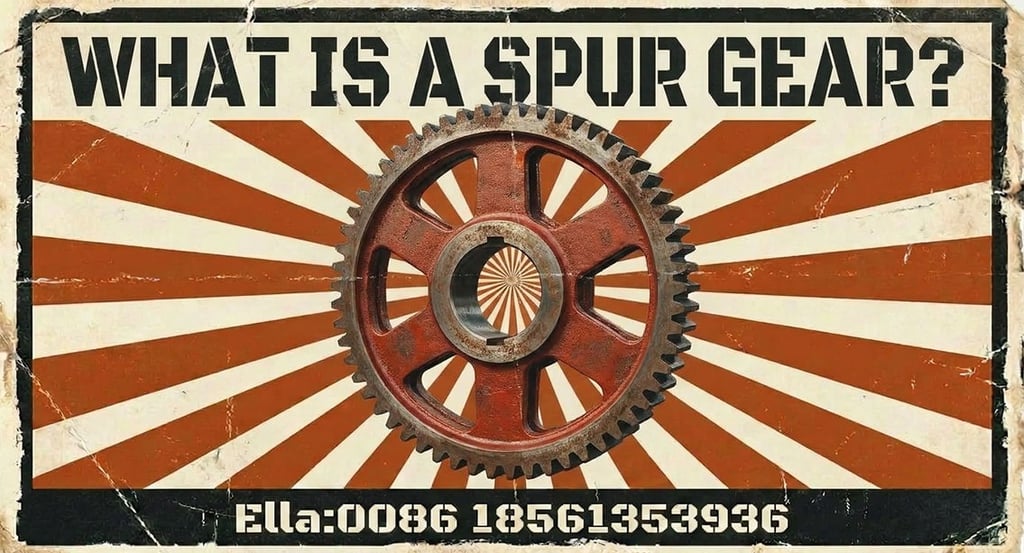
A spur gear is a cylindrical gear with teeth cut parallel to the axis of rotation. These teeth are "straight-cut," meaning they do not have a helix angle. When two spur gears mesh, they must be mounted on parallel shafts.
The primary purpose of a spur gear is to transmit motion and power from one shaft to another while maintaining a constant speed ratio. Because of their straight design, they do not produce axial thrust (force along the shaft), which simplifies the design of the bearings and housing within a gearbox.
2. The Geometry of a Spur Gear: The Magic of the Involute Profile
To truly understand what a spur gear is, we must look at the curve of its teeth. Most modern spur gears use an Involute Tooth Profile.
Why the Involute Curve?
An involute is a specific mathematical curve. When gear teeth are cut with this profile:
Constant Velocity: The gears maintain a perfectly constant speed ratio even if the center distance between the two gears varies slightly.
Reduced Wear: The teeth "roll" against each other rather than "sliding," which significantly reduces friction and heat.
Ease of Manufacturing: The involute profile can be generated using a straight-sided cutting tool (a hob), making high-precision production easier to achieve.
Key Geometrical Parameters:
Pitch Circle: The theoretical circle where the gears actually "meet" and transmit power.
Module (Metric) / Diametral Pitch (Imperial): The standard units used to measure tooth size. Gears must have the same module/pitch to mesh.
Pressure Angle: Usually 14.5° or 20°. This determines how the force is distributed across the tooth face. A 20° angle is more common in modern industrial applications as it provides a stronger tooth root.
3. Types of Spur Gear Configurations
Not all spur gears look like simple wheels. Depending on the application, they can be configured in three primary ways:
A. External Spur Gears
The most common type, where teeth are cut on the outside of the cylinder. When two external gears mesh, they rotate in opposite directions.
B. Internal Spur Gears
Here, the teeth are cut on the inside of a ring. A smaller external gear (pinion) sits inside.
Advantage: This configuration is more compact and offers better load distribution because more teeth are in contact at any given time.
Rotation: The internal and external gears rotate in the same direction.
C. Rack and Pinion
A "rack" is essentially a spur gear that has been unrolled into a flat bar. When the circular gear (pinion) rotates, it moves the rack in a linear direction. This is how the steering system in your car works.
4. Industrial Applications: Where Spur Gears Excel
Spur gears are found in almost every industry due to their versatility.
Manufacturing & Assembly Lines: Used in conveyor drives where precise timing and high efficiency are required.
Automotive: While main drive gears are often helical, spur gears are frequently used in reverse gears and starter motors.
Handheld Power Tools: The high efficiency of spur gears allows battery-powered tools to run longer per charge.
Heavy Machinery: In mining and construction, massive spur gears (often called "girth gears") drive large rotating kilns and ball mills.
Robotics: Precision spur gears are used in actuators where low backlash and accurate positioning are vital.
5. Manufacturing Processes: From Raw Steel to Precision Gear
As a custom gear manufacturer, we utilize several specialized processes to create high-quality spur gears:
1). Gear Hobbing
This is the most common method. A rotating cutting tool (the hob) progressively cuts the teeth into the gear blank. It is fast, accurate, and ideal for medium to large production runs.
2). Gear Shaping
Used primarily for internal gears or when a gear is located close to a shoulder. A reciprocating cutter "shapes" the teeth one by one.
3). Gear Grinding
For high-speed or high-precision applications (like aerospace), gears are ground after heat treatment. This removes any distortion caused by the hardening process and achieves a mirror-like finish on the teeth, reducing noise and wear.
4). Powder Metallurgy
For small, complex gears used in consumer electronics, metal powder is pressed into a mold and "sintered" in an oven. This is highly cost-effective for mass production.
6. Material Selection: Matching the Gear to the Load
The material determines the gear's torque capacity and lifespan.
Alloy Steels (4140, 8620): Often used and then "case-hardened" to create a hard, wear-resistant surface with a tough, impact-resistant core.
Stainless Steel: Essential for food-grade machinery or medical devices where corrosion resistance is mandatory.
Brass and Bronze: Often used for smaller gears to reduce friction and provide natural lubrication.
Nylon and Delrin (Plastics): Ideal for quiet, lightweight, and lubrication-free operation in printers and small appliances.
7. Failure Analysis: Why Do Spur Gears Fail?
To provide long-term value to your customers, it is important to understand common failure modes:
Pitting: Tiny cracks on the tooth surface caused by repeated stress (fatigue). Usually a sign of improper lubrication or overloading.
Scuffing: Damage caused by extreme heat, where the lubricating film breaks down and the metal teeth weld together momentarily.
Tooth Breakage: Often caused by sudden shock loads or foreign objects entering the mesh.
Abrasive Wear: Caused by contaminants (like sand or metal shavings) in the oil.
8. Conclusion: Why Partner with a Specialist?
So, what is a spur gear? It is more than just a wheel with teeth—it is a precision-engineered solution for power transmission. While the design is simple, the execution requires deep expertise in metallurgy, geometry, and manufacturing.
Qingdao Novi Machinery is a Spur Gear Manufacturer, we specialize in the design and production of custom spur gears that meet the most demanding AGMA and ISO standards. Whether you need a single prototype for an R&D project or a thousand gears for a production line, our engineering team is here to ensure your motion is perfect.
Ready to optimize your transmission system? Contact us for a custom spur gear quote today!
Looking for a reliable gear supplier for your project?
Send us your drawings or technical requirements, and our engineering team will provide a professional gear solution.
Address:Huangdao district,Qingdao city,Shandong province,China
© 2026. All rights reserved.
Quick Link