GET THE Exclusive discounts today!



What is a Worm Gear? The Complete Guide to Self-Locking Gears
What is a worm gear and how does it work? Explore our definitive guide on worm and wheel mechanics, self-locking safety features, reduction ratios, and industrial applications.
Sam
7/7/20256 min read
What is a Worm Gear? The Definitive Guide to High-Reduction, Self-Locking Gearing
In the vast landscape of mechanical engineering, most gear systems are designed for high-speed, rolling contact efficiency. However, there are times when an engineer’s greatest needs are not speed, but massive torque multiplication, extreme space-saving, and, most importantly, absolute safety. When these requirements meet, the only solution is the worm gear.
If you have ever wondered "What is a worm gear?", you have likely noticed a mechanism that looks more like a screw than a traditional gear. This unique configuration allows it to achieve things that spur and bevel gears simply cannot. In this extensive guide, we will explore the intricate mechanics, the self-locking phenomenon, and the specialized industrial roles that make the worm gear a masterpiece of power transmission.
1. Defining the Worm Gear: A Harmony of Screw and Wheel
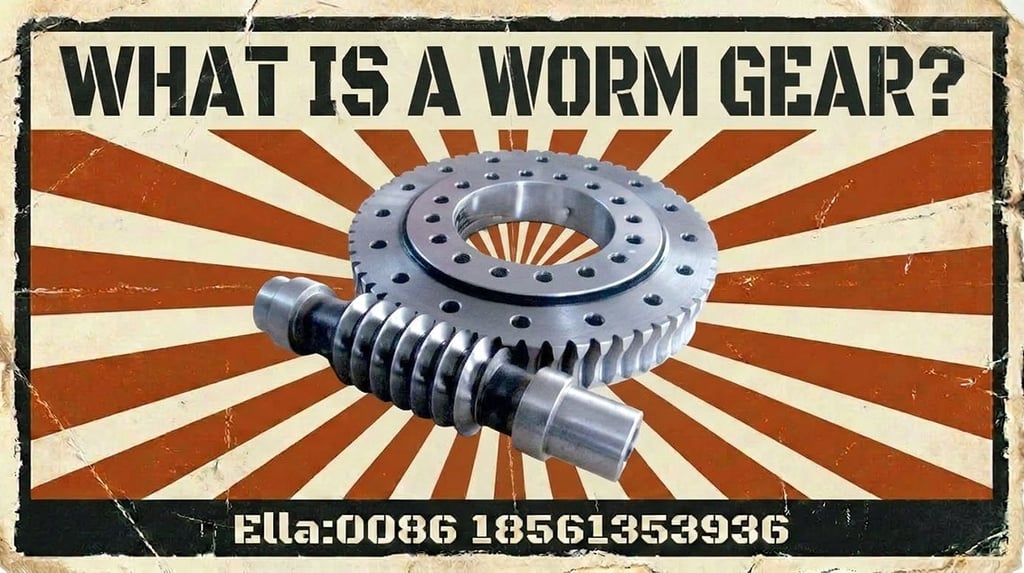
A worm gear is a specialized gear arrangement in which a "worm"—which is a gear in the form of a screw—meshes with a "worm wheel," which looks like a standard circular gear but with a specialized tooth profile.
Unlike the parallel shafts of spur gears or the intersecting shafts of bevel gears, worm gears are designed for non-parallel, non-intersecting shafts. Typically, these shafts are oriented at a 90-degree angle to one another. This "skew" orientation allows for a very compact footprint, making the worm gear the ideal choice for machinery where floor space or internal cabinet space is limited.
The motion of a worm gear is unique. Instead of the teeth "rolling" over one another, the threads of the worm "slide" across the teeth of the wheel. This sliding action is the defining characteristic of the worm gear, dictating everything from its high reduction ratios to its specialized lubrication needs.
2. The Mechanics of the Worm: Single-Start vs. Multi-Start
To understand the power of a worm gear, one must look at the "starts" on the worm. In a standard gear set, the gear ratio is determined by the number of teeth on both gears. In a worm gear set, the ratio is determined by the number of teeth on the wheel divided by the number of "starts" (or threads) on the worm.
A single-start worm has one continuous thread wrapped around the shaft. For every full 360-degree rotation of the worm, the worm wheel advances by only one tooth. This allows for an incredible speed reduction in a single stage—for example, a worm wheel with 60 teeth paired with a single-start worm results in a 60:1 reduction ratio.
A multi-start worm might have two, three, or four threads. While this reduces the total reduction ratio, it increases the efficiency and the speed of the output. By adjusting the number of starts, manufacturers can fine-tune a gearbox to balance the need for speed with the need for torque.
3. The Self-Locking Phenomenon: Engineering for Safety
Perhaps the most famous and valuable characteristic of the worm gear is its ability to be self-locking. In a spur gear or bevel gear system, if you apply force to the output shaft, you can usually "back-drive" the input shaft.
In many worm gear configurations, however, this is impossible. The friction between the sliding threads of the worm and the teeth of the wheel is so high that the wheel cannot turn the worm, regardless of how much force is applied. This occurs when the lead angle of the worm is very shallow (typically less than 5 to 10 degrees).
This self-locking feature is a critical safety mechanism. Consider a heavy-duty industrial elevator or a conveyor belt carrying heavy materials up a steep incline. If the motor fails or the power goes out, you do not want the weight of the load to pull the system backward. A self-locking worm gear acts as a natural, automatic brake, holding the load in place without the need for an external braking system.
4. The Efficiency Trade-off: Managing Heat and Friction
Every engineering choice involves a trade-off, and for the worm gear, that trade-off is efficiency. Because the gears rely on sliding motion rather than rolling contact, they generate a significant amount of friction.
While a high-quality helical gear set might operate at 98% efficiency, a high-ratio worm gear set may operate at only 50% to 70% efficiency. This lost energy is converted into heat. Therefore, worm gearboxes must be designed with robust cooling features, such as integrated cooling fins on the housing or specialized high-viscosity lubricants.
The choice of lubricant is more critical in a worm gear than in any other gear type. Because the sliding action can "wipe" the oil away from the contact point, specialized "compounded" oils or synthetic lubricants with extreme-pressure (EP) additives are required to prevent metal-to-metal contact and premature wear.
5. Dissimilar Metals: Why We Use Steel and Bronze
In most gear sets, engineers prefer to use the same material (usually hardened steel) for both gears to maximize strength. In a worm gear set, this would be a disaster. If two steel surfaces slide against each other under high pressure, they will "gall" or weld together almost instantly.
To solve this, worm gear sets are almost always made of dissimilar metals.
The Worm: Usually made of hardened steel or alloy steel, precision-ground to a mirror finish.
The Worm Wheel: Usually made of a softer, "sacrificial" material like phosphor bronze or manganese bronze.
The bronze wheel is designed to wear slowly over time, conforming perfectly to the shape of the steel worm. This "bedding-in" process actually increases the contact area and improves the efficiency of the gear set over its first few hundred hours of operation. When the gear set eventually reaches the end of its life, it is usually only the bronze wheel that needs to be replaced, saving the cost of a new steel worm.
6. Comparing Worm Gears to Helical and Bevel Systems
When deciding on a transmission layout, engineers often compare worm gears to helical or bevel gears. While bevel gears are excellent for 90-degree turns, they cannot achieve high reduction ratios in a single stage. A bevel gear set is usually limited to a 6:1 ratio, whereas a worm gear can easily reach 100:1 in the same amount of space.
When compared to helical gears, the worm gear is significantly quieter. The sliding contact of the worm threads is almost silent, whereas the engagement of helical teeth can create a high-pitched whine at high speeds. This makes worm gears the preferred choice for passenger elevators and stage equipment in theaters where silence is mandatory.
However, if high-speed continuous operation and energy efficiency are the primary goals, a helical-bevel combination is often superior to a standalone worm gear. The worm gear is the specialist for high-torque, intermittent duty, and space-constrained safety applications.
7. Vital Industrial Applications of Worm Gears
The unique benefits of worm gears make them indispensable in several key industries:
Material Handling and Conveyors: The self-locking feature prevents belts from slipping backward under load.
Mining and Heavy Machinery: Used in "slue drives" for rotating massive cranes and excavators where precise, slow-speed rotation is required.
Automotive Steering: While many cars use rack and pinion, older luxury vehicles and heavy trucks often used worm and sector steering for its smooth feel and high mechanical advantage.
Escalators and Elevators: The combination of quiet operation and inherent safety makes them the industry standard.
Musical Instruments: The tuning pegs on a guitar are actually tiny worm gears. They allow you to tighten a string with great precision and ensure the string doesn't "unwind" itself under tension.
Gate Openers: Modern automated gates use worm drives to ensure the gate cannot be forced open by hand once it is closed.
8. Manufacturing Excellence: Precision Hobbing and Threading
Creating a high-performance worm gear set requires extreme manufacturing precision. At Qingdao Novi Machinery, we focus on two critical areas:
Worm Threading: The worm must be machined with a perfect lead angle and surface finish. Any microscopic roughness on the steel threads will act like sandpaper against the bronze wheel, leading to rapid failure.
Worm Wheel Hobbing: The teeth of the wheel are not straight; they are curved (throated) to wrap around the worm. This increases the contact area (the "Enveloping" effect) and allows the gears to carry much higher loads.
We utilize state-of-the-art CNC gear hobbing machines to ensure that the "contact pattern" between the worm and wheel is perfectly centered, maximizing the life of the bronze components.
9. Conclusion: The Power of the Worm Gear
So, what is a worm gear? It is the engineer’s answer to the challenges of space, safety, and torque. While it may not be the most efficient gear in the catalog, its ability to provide massive speed reduction and a natural fail-safe through self-locking makes it a cornerstone of modern industrial design.
Understanding the nuances of the worm gear—from the selection of bronze alloys to the management of thermal loads—is what separates a standard gearbox from a high-performance transmission system.
At Qiingdao Novi Machinery, we specialize in the art of custom worm gearing. Whether you are designing a new conveyor system or need a high-precision actuator for a robotic arm, our team is here to help you select the right materials, ratios, and configurations for your success.
Ready to discuss your custom worm gear project? Contact our engineering team today for a detailed consultation!
Looking for a reliable gear supplier for your project?
Send us your drawings or technical requirements, and our engineering team will provide a professional gear solution.
Address:Huangdao district,Qingdao city,Shandong province,China
© 2026. All rights reserved.
Quick Link