GET THE Exclusive discounts today!



What Is Gear?The Complete Guide to Mechanical Gearing Basics
What is gear and how does it work? Explore our definitive guide on gear definitions, anatomy, history, and manufacturing. Learn the basic principles of mechanical power transmission.
Jenny
5/6/20264 min read
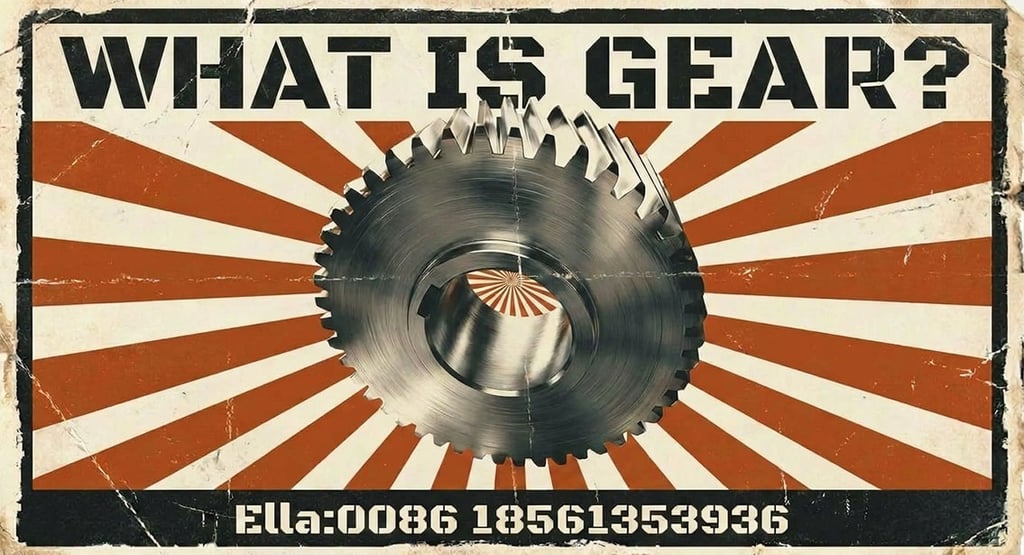
What is Gear? The Ultimate Guide to Mechanical Gearing Principles
In every corner of our modern world—from the hands of a watch to the massive turbines of a hydroelectric dam—gears are at work. They are the fundamental building blocks of the machine age. But if we strip away the complexity of modern machinery, we are left with a simple, profound question: What is a gear, exactly?
At its simplest, a gear is a rotating circular machine part having cut teeth that mesh with another toothed part to transmit torque. However, to an engineer, a gear is a precision instrument designed to manipulate physics. In this definitive guide, we will explore the definition, history, anatomy, and fundamental science of gears.
1. The Formal Definition: What is a Gear?
In mechanical engineering, a gear is defined as a component within a transmission system that transmits rotational force (torque) to another gear or device.
Unlike a pulley system which uses belts, or a sprocket system which uses chains, gears engage directly through meshing. When two gears mesh, the teeth of one gear push against the teeth of the other. This direct contact ensures that there is no "slip," allowing for precise timing and massive power transfer.
The "Law of Gearing"
For a gear to function correctly, the "Law of Gearing" must be satisfied. This law states that the common normal at the point of contact between two teeth must always pass through a fixed point on the line joining the centers of the two gears (the pitch point). This ensures a constant angular velocity ratio, which is why your car or your factory machines run smoothly rather than jerking.
2. A Brief History: From Ancient Wooden Cogs to Modern Precision
To understand what a gear is, we must look at where they came from. Gears are not a modern invention; they are one of the oldest technologies in human history.
Ancient Greece (270-200 BC): The famous Antikythera mechanism used bronze gears to calculate astronomical positions with incredible accuracy.
The Industrial Revolution: The transition from wooden "cogs" to cast iron and eventually steel gears allowed humans to build the first steam engines and automated factories.
The 21st Century: Today, we use CNC (Computer Numerical Control) machining and precision grinding to create gears with tolerances measured in microns (0.001mm).
3. How Do Gears Work? The Three Core Functions
Why do we use gears? Every gear system in existence is designed to do at least one of these three things:
A. Changing Torque (Power Multiplication)
This is the most common use. By meshing a small gear (driving) with a large gear (driven), you trade speed for power. This is how a small electric motor can lift a heavy elevator or move a massive crane.
B. Changing Speed
Conversely, if you mesh a large gear with a smaller one, the small gear will spin much faster. This is essential in applications like wind turbines, where the slow rotation of the blades must be sped up to generate electricity.
C. Changing Direction
Gears can change the orientation of motion. For example, bevel gears can take horizontal rotation from an engine and turn it 90 degrees to drive vertical wheels.
4. The Anatomy of a Gear: Essential Terminology
To talk like a gear expert, you need to understand the anatomy of a gear. Here are the "Big Five" terms:
The Pitch Circle: The theoretical circle upon which all calculations are based. When two gears mesh, their pitch circles are tangent to each other.
Module (M): The ratio of the pitch diameter to the number of teeth. It is the international standard for gear size.
Pressure Angle: The angle between the line of force and the line to the center of the gear. Common angles are 14.5° and 20°.
Addendum & Dedendum: The addendum is the height of the tooth above the pitch circle; the dedendum is the depth below it.
Backlash: The tiny gap between mating gear teeth. While it sounds like a flaw, a small amount of backlash is necessary to prevent jamming and allow for lubrication.
5. What are Gears Made Of?
The "What is gear" question also involves materials. The environment dictates the material:
Steel (Carbon & Alloy): The gold standard for industrial gears due to high strength and durability.
Brass/Bronze: Used in worm gears to reduce friction and prevent sparks.
Plastic (Nylon/Acetone): Found in printers, toys, and appliances where quiet operation and low weight are more important than torque.
Specialty Alloys: Titanium or Inconel are used in aerospace for extreme heat resistance.
6. Gear Manufacturing: How a Gear is Born
Creating a gear is a process of extreme precision. At Qingdao Novi Machinery, we follow several key steps:
Blanking: Cutting the initial cylindrical shape from raw metal.
Hobbing: Using a specialized cutting tool (a hob) to generate the tooth profile.
Heat Treatment: Hardening the steel to ensure it can withstand millions of cycles of stress.
Grinding: The final step to ensure the tooth surface is perfectly smooth and accurate.
7. The Importance of Custom Gearing
While you can buy "off-the-shelf" gears, many high-performance machines require custom gears. Why?
Optimized Weight: In aerospace, every gram counts.
Unique Ratios: Sometimes a standard 2:1 ratio isn't enough; you might need 2.135:1 for a specific scientific instrument.
Extreme Environments: Standard gears fail in deep-sea or space environments.
8. Conclusion: The Future of Gears
So, what is gear? It is more than just a piece of metal with teeth. It is the physical manifestation of human ingenuity, allowing us to control the forces of nature and power the world. As we move into the era of robotics and electric vehicles, the gear is not becoming obsolete; it is becoming more precise, more efficient, and more vital than ever.
Qingdao Novi Machinery is a Spur Gear Manufacturer, we have spent decades perfecting the art and science of the gear. From basic Custom Industrial Spur Gear to complex custom assemblies, we understand that every tooth matters.
Have a question about gear design? Contact our engineering team today!
Looking for a reliable gear supplier for your project?
Send us your drawings or technical requirements, and our engineering team will provide a professional gear solution.
Address:Huangdao district,Qingdao city,Shandong province,China
© 2026. All rights reserved.
Quick Link