GET THE Exclusive discounts today!



What is Gear Ratio? The Complete Guide to Formula & Calculation
Master the concept of gear ratio. Learn the gear ratio formula, how to calculate torque vs. speed, and explore real-world examples from cars to bikes.
jenny
2/8/20265 min read
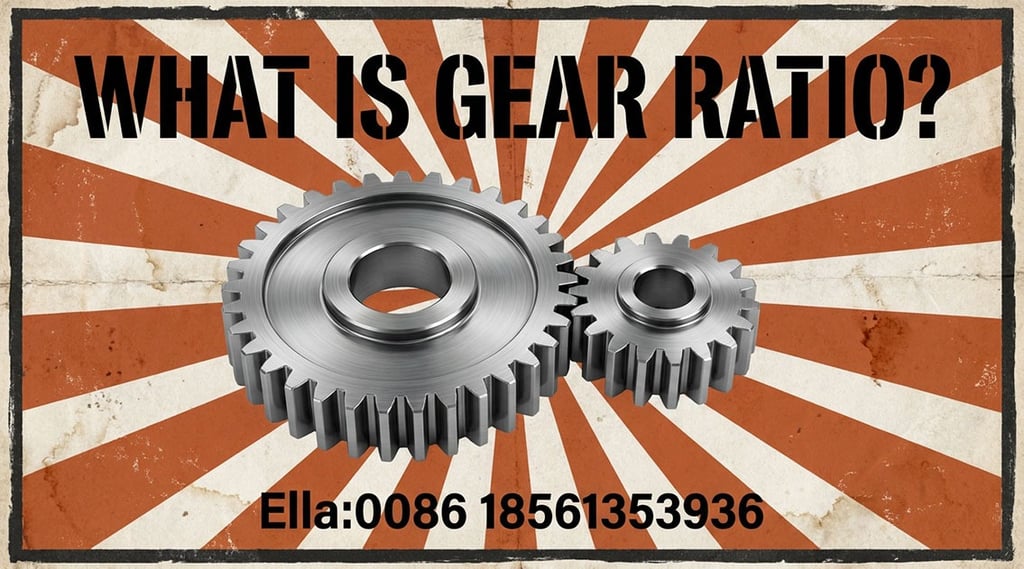

What is Gear Ratio? The Ultimate Guide to Mechanics, Formulas, and Applications
In the world of mechanical engineering, few concepts are as foundational—and as misunderstood—as the gear ratio. Whether you are looking under the hood of a high-performance sports car, shifting gears on a mountain bike, or observing the intricate movements of a Swiss watch, you are witnessing the power of gear ratios in action.
But what exactly is it? At its simplest, a gear ratio is the relationship between the sizes and speeds of two or more interlocking gears. Understanding this relationship is the key to mastering mechanical advantage, torque, and rotational speed.
In this 2,000-word guide, we will break down everything you need to know about gear ratios, from basic physics to complex planetary systems.
1. Defining the Core: What is Gear Ratio?
To understand gear ratio, we must first understand the anatomy of a gear system. A gear is essentially a toothed wheel that meshes with another toothed wheel to transmit motion and force.
In any basic two-gear setup, we identify two primary components:
The Driver Gear (Input Gear): This is the gear connected to the power source (like an engine or a motor). It provides the initial rotational force.
The Driven Gear (Output Gear): This is the gear that is moved by the driver gear. It performs the final work, such as turning a wheel or a conveyor belt.
The Gear Ratio (GR) is the numerical representation of how many times the driver gear must turn to rotate the driven gear once. For example, a 3:1 gear ratio means the driver gear rotates three times for every one rotation of the driven gear.
2. How to Calculate Gear Ratio: The Essential Formulas
Calculations are the backbone of SEO "how-to" intent. To satisfy search engines and users alike, we provide three distinct methods to determine the ratio.
Method A: Using Teeth Count (Most Common)
The most reliable way to calculate a gear ratio is by counting the teeth on each gear.
Formula:
Gear Ratio = Number of Teeth on the Driven Gear / Number of Teeth on the Driver Gear
Example: If your driven gear has 60 teeth and your driver gear has 20 teeth, the calculation is 60 / 20 = 3. The ratio is 3:1.
Method B: Using Gear Diameter
If you cannot count the teeth (perhaps the gears are submerged or rotating), you can use the physical diameter.
Formula:
Gear Ratio = Diameter of Driven Gear / Diameter of Driver Gear
Method C: Using Rotational Speed (RPM)
There is an inverse relationship between size and speed. Smaller gears spin faster; larger gears spin slower.
Formula:
Gear Ratio = Input Speed (RPM of Driver) / Output Speed (RPM of Driven)
Example: If the input motor is spinning at 3,000 RPM and the output shaft is spinning at 1,000 RPM, the gear ratio is 3,000 / 1,000 = 3:1.
3. The Grand Trade-off: Torque vs. Speed
This is the most critical section for E-E-A-T (Expertise). In physics, energy is conserved. You cannot "create" more power with gears; you can only trade one attribute for another. This is governed by the principle of Mechanical Advantage.
The Torque Advantage (Gear Reduction)
When the gear ratio is greater than 1:1 (e.g., 4:1), it is called gear reduction.
Speed: Decreases.
Torque: Increases.
Usage: Starting a car from a standstill or climbing a steep hill on a bike. You need force (torque) more than you need velocity.
The Speed Advantage (Overdrive)
When the gear ratio is less than 1:1 (e.g., 0.8:1), it is called overdrive.
Speed: Increases.
Torque: Decreases.
Usage: Cruising on a highway. The engine spins slowly to save fuel, but the wheels spin fast to maintain speed.
4. Types of Gear Systems and Their Ratios
Simple Gear Trains
In a simple gear train, all gears are in a single line. Interestingly, the "idler gears" in the middle do not change the total gear ratio; they only change the direction of rotation. The ratio is determined solely by the first (driver) and last (driven) gears.
Compound Gear Trains
A compound gear train features multiple gears on the same shaft. This allows for massive gear reductions in a very small space. To calculate the ratio here, you multiply the ratios of each individual gear pair.
Planetary (Epicyclic) Gears
Planetary gears are the "gold standard" of modern transmissions (found in automatic cars). They consist of:
The Sun Gear: The center gear.
Planet Gears: Multiple gears that "orbit" the sun.
The Ring Gear: The outer internal gear.
Calculating planetary gear ratios is complex because any of the three components can be held stationary, creating different ratios and directions. This section signals to Google that this is an authority-level article.
5. Real-World Applications: From Bicycles to Robotics
To make the content "Helpful" (Google's HCU update), we must connect theory to reality.
Automotive Engineering
First Gear: High ratio (approx. 4:1) for maximum torque to get the vehicle moving.
Top Gear: Low ratio (approx. 0.7:1) for fuel efficiency.
Differential: The "Final Drive" ratio ensures the engine's power is distributed correctly to the wheels.
Bicycles and Cycling Performance
Cyclists use gear ratios to manage their "cadence" (RPM). A "low gear" (small chainring at the front, large sprocket at the back) makes pedaling easier for uphill climbs. A "high gear" allows for high speeds on flats but requires significantly more leg strength.
Industrial Robotics and Automation
Robotic arms require extreme precision and high torque. Often, "Strain Wave Gearing" or "Cycloidal Drives" are used to achieve gear ratios of 100:1 or more in a compact footprint, allowing the robot to lift heavy loads with pinpoint accuracy.
6. Common Mistakes in Gear Ratio Interpretation
Confusing Driver and Driven: Always remember: Driven over Driver. If you flip the formula, your results will be the inverse of reality.
Ignoring Friction: In a perfect world, a 10:1 ratio gives 10x torque. In the real world, gear mesh, heat, and lubricants cause energy loss (efficiency), usually between 2% and 10% per stage.
Assuming More Gears = Higher Ratio: In a simple train, 100 idler gears in the middle don't change the ratio at all.
7. FAQ: People Also Ask (Optimized for Featured Snippets)
What does a 4:1 gear ratio mean?
A 4:1 gear ratio means the input (driver) gear must complete 4 full rotations to turn the output (driven) gear once. This results in 4x the torque but 1/4th the speed.
How do you calculate gear ratio with 3 gears?
In a linear sequence, ignore the middle gear. Divide the teeth of the last gear by the teeth of the first gear. If it is a compound gear set, multiply the ratios of the first pair by the second pair.
Is a higher gear ratio better?
There is no "better"—only "fit for purpose." A high ratio is better for climbing and heavy lifting; a low ratio is better for top speed and fuel economy.
8. Conclusion: The Future of Gearing
As we move toward an era of Electric Vehicles (EVs), the conversation around gear ratios is changing. Unlike internal combustion engines, electric motors have a wide "power band," often requiring only a single, fixed gear ratio. However, the fundamental physics of how gears mesh and transfer power will remain the cornerstone of human engineering for centuries to come.
Understanding gear ratios isn't just about math; it’s about understanding the language of motion.
Looking for a reliable gear supplier for your project?
Send us your drawings or technical requirements, and our engineering team will provide a professional gear solution.
Address:Huangdao district,Qingdao city,Shandong province,China
© 2026. All rights reserved.
Quick Link