GET THE Exclusive discounts today!



What is Pressure Angle in Gear?The Ultimate Technical Guide
What is a gear pressure angle and why does it matter? Discover the difference between 14.5 vs 20 degree pressure angles, impact on tooth strength, noise, and bearing life.
Sam
1/10/20266 min read
What is Pressure Angle in Gear? The Definitive Engineering Guide to Tooth Geometry
In the field of mechanical engineering, there are few concepts as fundamental yet as frequently misunderstood as the pressure angle. If you have ever looked at a gear specification sheet, you have undoubtedly seen numbers like 14.5° or 20°. While they may seem like minor technical details, these angles are the "DNA" of the gear tooth. They dictate how much power the gear can transmit, how much noise it will make, and how long the bearings in your machine will last.
If you are asking, "What is pressure angle in gear?", you are essentially asking how the force is directed from one tooth to another. In this comprehensive guide, we will strip away the mystery surrounding this invisible but vital angle. We will explore its geometric origin, the historical debate between standard angles, and the practical implications for modern industrial design.
1. The Geometric Definition: Visualizing the Invisible
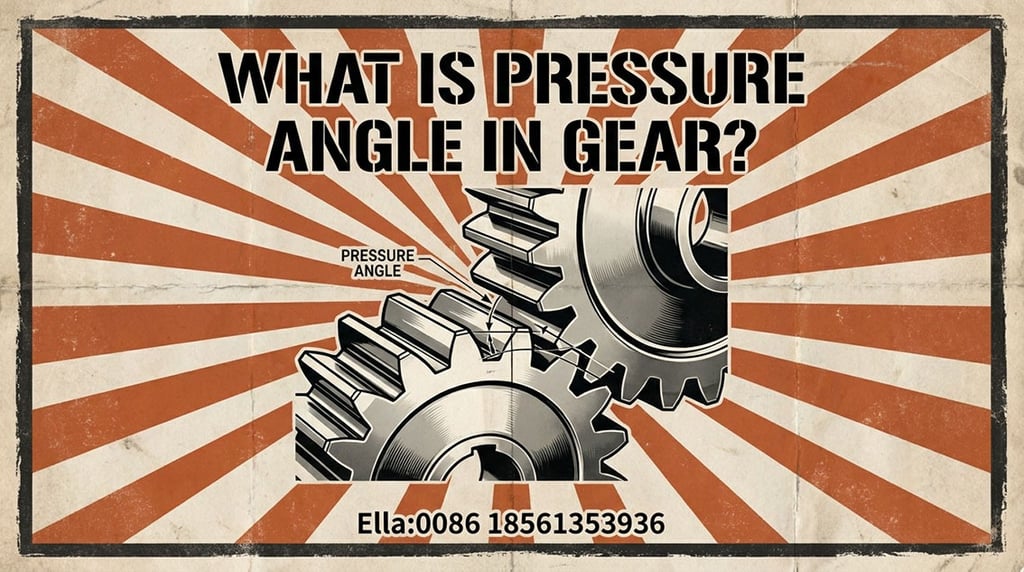
To understand the pressure angle, we must first visualize the point where two gears meet. Imagine two gears in mesh. As they rotate, there is a specific line along which the force is transmitted from the driving tooth to the driven tooth. This is known as the Line of Action or the Pressure Line.
The pressure angle is defined as the angle between this Line of Action and a line tangent to the pitch circles of the gears. In simpler terms, if you were to draw a line perfectly perpendicular to the surface of the gear tooth at the point of contact, the angle at which that line "leans" away from the direction of motion is the pressure angle.
This angle is not arbitrary. In an involute gear system—the standard for almost all modern machinery— the pressure angle remains constant throughout the entire period of engagement. This ensures that the speed ratio between the gears remains perfectly steady, preventing the vibration and "jerking" that would occur if the angle were to shift.
2. The Relationship Between the Base Circle and Pitch Circle
To go deeper into the engineering of the pressure angle, we must look at the Base Circle. The involute curve (the shape of the gear tooth) is generated from this base circle. The pressure angle is the mathematical "bridge" that connects the base circle to the pitch circle (the theoretical diameter where the gears meet).
The math is elegant: the radius of the base circle is equal to the radius of the pitch circle multiplied by the cosine of the pressure angle.
Why does this matter? Because it shows that the pressure angle literally determines the shape of the tooth. A smaller pressure angle results in a tooth that is thinner at the base and more "curved" toward the top. A larger pressure angle creates a tooth that is wider at the base and appears "stubbier." This physical change in shape is the root cause of every performance difference we see in industrial gearboxes.
3. Standard Pressure Angles: A Tale of Two Systems
In the modern era, two standard pressure angles dominate the market: 14.5 degrees and 20 degrees. Understanding why these two exist—and why one is slowly replacing the other—is essential for any procurement or design professional.
The 14.5-Degree Pressure Angle: The Historical Standard
For many decades, 14.5° was the undisputed king of gearing. The reason was actually based on the limitations of early mathematics and manual machining. The sine of 14.5° is approximately 0.25 (or 1/4). This simple fraction made it much easier for 19th-century engineers to perform gear calculations by hand.
Beyond the math, 14.5° gears offered a specific advantage: a high Contact Ratio. Because the teeth are more slender, more than one tooth is often in contact at the same time. This leads to exceptionally smooth and quiet operation. Today, you will still find 14.5° gears in precision instruments, clocks, and consumer electronics where noise reduction is more important than raw power.
The 20-Degree Pressure Angle: The Modern Industrial Workhorse
As the Industrial Revolution progressed and machinery became more powerful, the 14.5° gear began to show its weaknesses. It was prone to "undercutting" (the weakening of the tooth root during manufacturing) and could not handle the massive torque loads of modern engines and motors.
The 20° pressure angle was developed to solve these problems. It has become the global standard for heavy machinery, automotive transmissions, and industrial automation. By increasing the angle, engineers created a tooth that is significantly stronger and more resistant to interference.
4. The Performance Trade-offs: Strength vs. Smoothness
Choosing a pressure angle is an exercise in balancing conflicting priorities. When you increase the pressure angle from 14.5° to 20° (or even 25°), several things happen simultaneously.
Tooth Strength and Torque Capacity
The most immediate benefit of a larger pressure angle is a wider tooth base. In physics, a wider base means the tooth acts like a stronger cantilever beam. It can withstand much higher "bending stress" before it snaps. If you are designing a gearbox for a mining truck or a high-torque industrial mixer, a 20° or 25° angle is the only logical choice to prevent tooth breakage.
Managing Undercutting and Interference
One of the biggest headaches for gear designers is undercutting. This happens when a gear has a very small number of teeth. During the manufacturing process, the cutting tool accidentally removes metal from the base of the tooth, making it fragile.
A larger pressure angle dramatically reduces the risk of undercutting. While a 14.5° gear might start to undercut at 32 teeth, a 20° gear can go down to 18 teeth, and a 25° gear can go even lower without losing its structural integrity. This allows for much more compact gearbox designs.
Noise and Vibration
This is where the smaller pressure angle (14.5°) wins. Because the teeth are more slender and curved, they engage more gradually. This creates a "rolling" contact that is naturally quieter. 20-degree gears, being stubbier, tend to be slightly noisier and can produce more vibration at extremely high speeds. In high-end luxury vehicles or sensitive medical equipment, this noise factor can be a deal-breaker.
5. The Impact on Bearing Life: The Hidden Cost
One of the most overlooked aspects of the pressure angle is its impact on Bearing Loads. When power is transmitted between gears, the force is not just trying to turn the gear; it is also trying to push the two gears apart.
This "separating force" is directly related to the pressure angle. As the pressure angle increases, the radial force (the force pushing the shafts away from each other) increases significantly. This force must be absorbed by the bearings and the housing of the machine.
If you switch from a 14.5° gear to a 25° gear without upgrading your bearings, you may find that your bearings fail prematurely. The larger angle puts much more stress on the internal support structure of the machine. Therefore, a "stronger" gear tooth might actually result in a "weaker" overall machine if the bearings aren't properly specified.
6. Manufacturing Considerations: Tooling and Hobbing
As a gear manufacturer, we must consider the "producibility" of these angles. The pressure angle is "built into" the cutting tool (the hob or shaper cutter). You cannot cut a 20° gear with a 14.5° tool.
This means that standardization is vital for cost control. Because 20° is the most common angle, the tooling is more readily available and less expensive. If you specify a non-standard pressure angle (such as 17.5° or 22.5°), your manufacturing costs will skyrocket because custom cutting tools must be designed and ordered.
Furthermore, higher pressure angles are generally easier to manufacture with high precision. They have a larger "tolerance" for small errors in center distance between the shafts. This makes them more forgiving in real-world assembly environments where perfect alignment is difficult to achieve.
7. How to Choose the Right Pressure Angle?
While every application is unique, we generally follow these professional guidelines:
Choose 14.5 Degrees if: You are building a precision instrument, a low-load consumer device, or any machine where silence is the absolute priority. It is also the correct choice if you are maintaining or repairing legacy machinery built before the 1950s.
Choose 20 Degrees if: You are designing modern industrial equipment, automotive parts, or high-torque drives. This is the "safe" default for 90% of modern engineering projects.
Choose 25 Degrees if: You are dealing with extreme heavy-duty applications, such as earth-moving equipment or aerospace actuators, where space is extremely limited and you must maximize every bit of tooth strength.
8. Conclusion: The Foundation of Every Mesh
So, what is pressure angle in gear? It is the invisible geometry that determines the balance of power in your machine. It is the compromise between the silence of the 14.5-degree curve and the brute strength of the 20-degree wedge.
Understanding this angle allows you to look beyond the surface of a gear and see its true performance potential. It allows you to predict how a machine will sound, how much weight it can carry, and how long its bearings will survive.
At Qingdao Novi Machinery, we specialize in the precision calculation and manufacturing of all gear profiles. Our engineering team doesn't just cut teeth; we optimize geometry. Whether you need the quiet operation of a specialized 14.5° set or the indestructible power of a custom 25° industrial drive, we have the expertise and the tooling to bring your design to life.
Are you unsure which pressure angle is best for your specific load and speed requirements? Contact our engineering team today for a technical consultation!
Looking for a reliable gear supplier for your project?
Send us your drawings or technical requirements, and our engineering team will provide a professional gear solution.
Address:Huangdao district,Qingdao city,Shandong province,China
© 2026. All rights reserved.
Quick Link