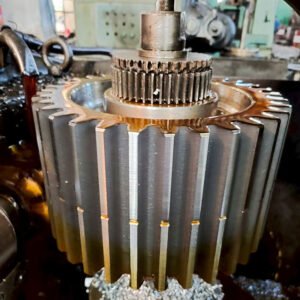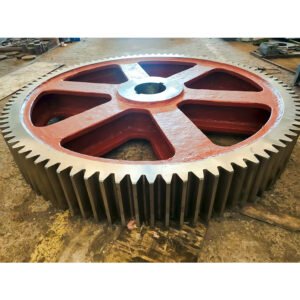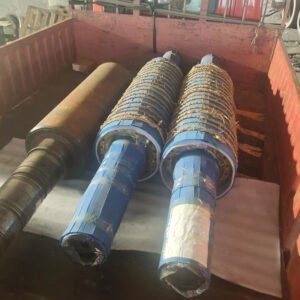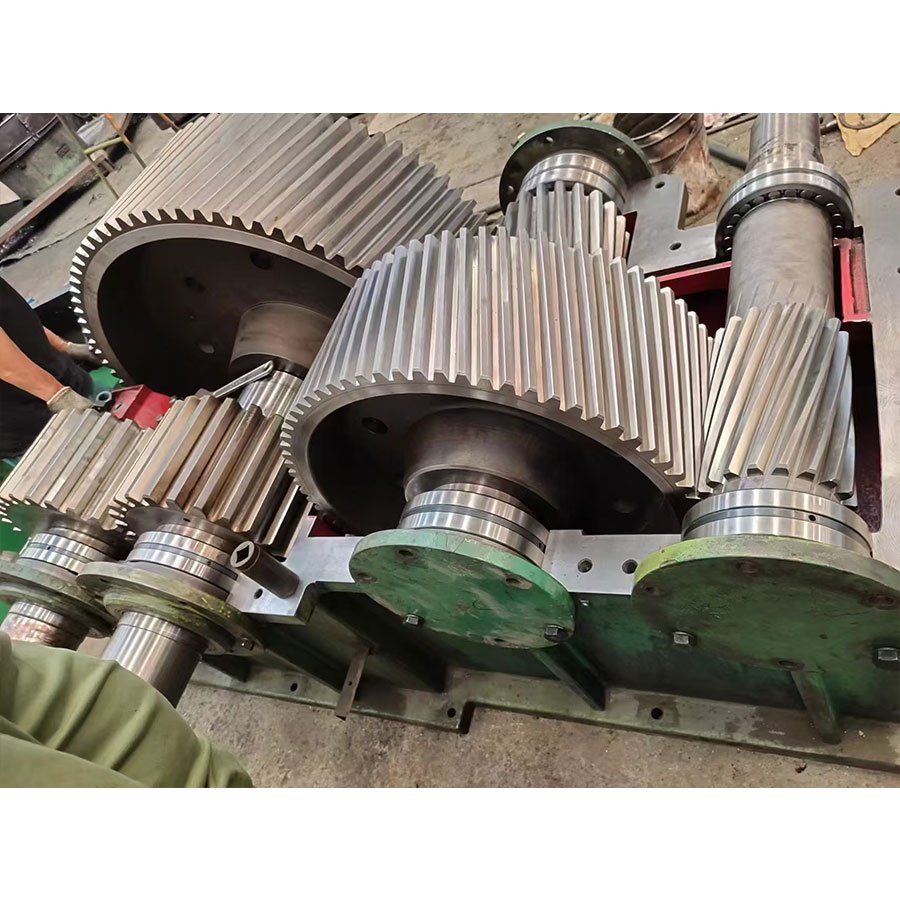
Internal mixers operate under immense pressure and intermittent shock loads. For this project, we manufactured gearboxes for a 270L internal mixer, with a total quantity of 12 units, focusing on extending service life and ensuring stable power transmission through advanced material selection, precision hobbing, and carburizing & grinding processes.
| Gear Type | Helical Gear/ Gearbox |
| Module | M8 / M9 / M12 |
| Material | 20CrMnTi |
| Quantity | 12 Units |
| Processing | Gear Hobbing / Gear Grinding |
| Heat Treatment | Quenching & Tempering |
| Tooth Surface Treatment | Carburizing |
| Accuracy Class | DIN 7 |
One gearbox, three modules
A 270L mixer’s drive is not a single pair. The 12 gears on this order span M8, M9 and M12 because the gearbox reduces speed in stages — the M8 gears sit in the high-speed input stage where tooth count is high and pitch line velocity peaks, the M12 gears in the final stage where torque is greatest and the fewest teeth carry it. Matching module to stage is what keeps the whole train inside its rating.
The Engineering Advantage
Superior Material Strength: By using 20CrMnTi alloy steel, combined with carburizing treatment, these gears possess excellent wear resistance and fatigue strength, fully adapting to the rigorous working cycles of internal mixers.
DIN 7 Grinding Precision: Our state-of-the-art gear grinding technology ensures DIN 7 accuracy, which significantly minimizes vibration, reduces heat generation, and prevents premature gear failure.
Optimized Heat Treatment & Tooth Surface Process: Quenching & tempering treatment ensures the gear core toughness, while carburizing & grinding enhance the tooth surface hardness, forming a perfect combination of toughness and wear resistance to cope with the high-pressure and impact environment of internal mixers.
Why carburizing, not through-hardening
A through-hardened gear is uniformly hard, which leaves nothing to absorb the shock of a paddle meeting a cold batch. 20CrMnTi carburized and then ground keeps a tough, low-carbon core under a hard case: the tooth can deflect under impact without cracking, while the flank still resists pitting. Quenching and tempering before carburizing sets that core toughness deliberately instead of leaving it to the alloy.
Result
These 12 custom helical gears provided the client with a reliable power transmission solution, significantly improving the operational stability and service life of their 270L internal mixer, and reducing maintenance costs and downtime caused by gear failure.
FAQ
Q: Can these gears replace the set in an older 270L mixer?
A: Yes — send the original drawing or the worn gears. Tooth count and helix angle are held so the reduction ratio stays unchanged.
Q: How do I know which module my gearbox uses?
A: Module follows the stage: measure the reference diameter and count teeth on the worn gear, and the module falls out of the division. Mixed modules in one gearbox are normal.