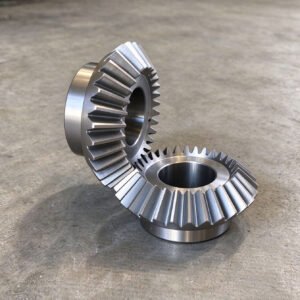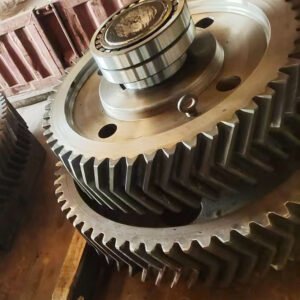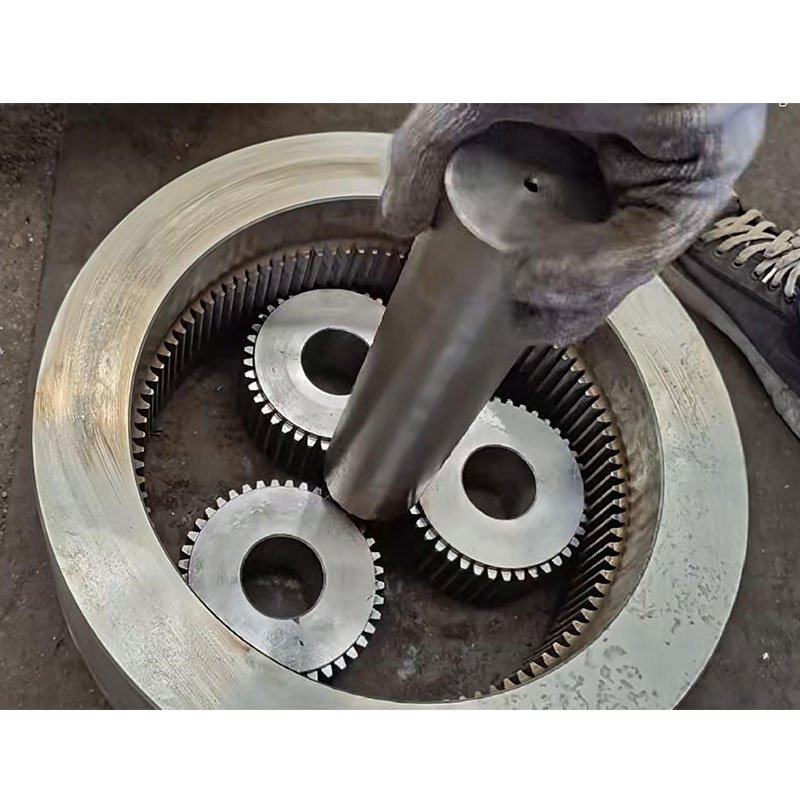
This build is two complete planetary gear sets for a ship’s motor drive: sun gear, three planet gears and the internal ring gear, all cut from 40Cr, quenched and tempered, then high-frequency quenched on the tooth flanks. Both sets replace worn originals inside housings that were not going to be re-machined, so every dimension that touches the assembly had to come back to the drawing.
| Gear Type | Planetary Gear Set (sun + 3 planets + internal ring gear) |
| Module | M2 |
| Material | 40Cr |
| Quantity | 2 Units |
| Processing | Gear Hobbing |
| Heat Treatment | Quenching & Tempering |
| Tooth Surface Treatment | High-Frequency Quenching |
| Accuracy Class | DIN 8 |
Why 40Cr, and why quench and temper first
40Cr at 0.40% carbon and around 1% chromium is a through-hardening steel, and quenching followed by high-temperature tempering is what makes it usable in a marine drive. The temper draws the as-quenched martensite back to tempered sorbite at roughly 28-32 HRC: hard enough to carry torque, ductile enough to yield instead of crack when the propeller loads the train in reverse or the hull slams into a sea. Skip the temper and the same steel becomes the wrong kind of hard, and a tooth chips on the first shock load.
Where the high-frequency quenching stops
High-frequency quenching is applied after the teeth are cut, and only down to the depth the tooth actually needs. Induction heats the flank in seconds, the quench follows immediately, and the result is 50-55 HRC at the surface falling away to the tempered core across 1-3 mm, scaled to module. That gradient is the whole point: the case resists pitting and abrasive wear, while the core absorbs bending stress at the root. Because the hardened zone stays shallow, distortion remains inside the DIN 8 tolerance band and no grinding step is needed at this grade.
Two sets, one measurement
Two sets put the emphasis somewhere unusual. One set can be right on its own; two sets have to be right together, because they go in as a pair and no service crew will accept a shim pack that only works on one side. Tooth thickness is measured against the same base for the first and the last part, backlash is checked at each of the three planet positions rather than one, and both sets are assembled dry for a contact pattern before they are stripped, cleaned and packed.
What ships with the order
MTC to EN 10204 3.1 accompanies both sets, with dimensional reports on request. If you are replacing a marine planetary set, send the drawing or the worn parts; photographs of the failure help as well. Module, tooth counts and centre distance decide whether the set closes, and how a gear train transmits torque explains the geometry behind those three numbers.