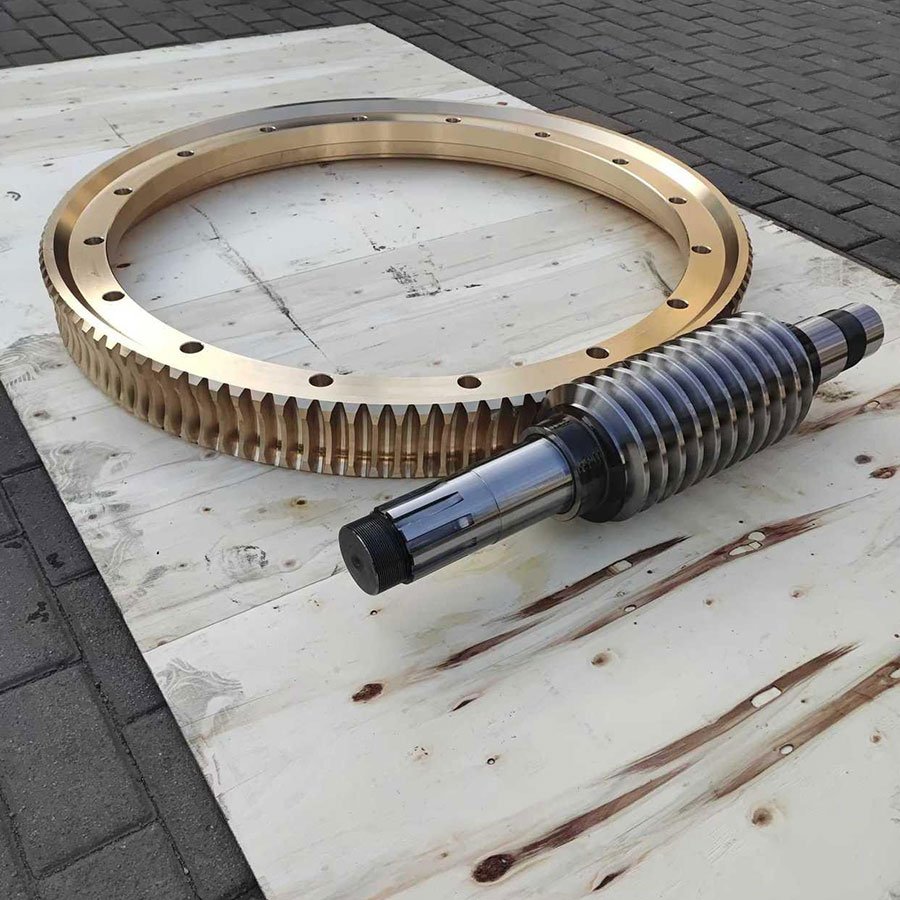
The mold opening and closing sequence in tire vulcanization requires smooth, high-torque transmission with reliable positioning. We recently manufactured 3 units of custom M6 worm gear sets for a prominent tire company. This project highlights our expertise in utilizing specialized material pairings—Tin Bronze and Alloy Steel—to minimize friction and maximize the operational life of industrial gearboxes.
| Gear Type | Worm gear set |
| Module | M6 |
| Material | Worm Gear-ZCuSn10Pb1 / Worm-40Cr |
| Quantity | 3 Units |
| Processing | Gear Hobbing |
| Heat Treatment | Quenching & Tempering |
| Tooth Surface Treatment | High-Frequency Quenching |
| Accuracy Class | DIN 9 |
Engineering Highlights
Optimized Material Pairing: By pairing a ZCuSn10Pb1 tin bronze worm wheel with a hardened 40Cr worm, we achieved an exceptionally low friction coefficient. This combination is critical for reducing heat generation and preventing galling in the high-frequency cycles of tire molding.
Enhanced Surface Hardness: The worm teeth underwent high-frequency quenching to reach the optimal hardness levels required to drive the bronze wheel without excessive wear, ensuring long-term precision in the mold-clamping mechanism.
High-Ratio Torque Control: The M6 module design provides the necessary mechanical advantage and self-locking potential required to maintain the mold’s position securely during the curing transition phases.
Worm and worm gear sets are widely used for compact low-speed reducers and positioning devices. Compared to spur gear, worm gear can achieve a huge reduction ratio in one single stage and has optional self-locking function. Compared to helical gear, worm drive has lower transmission efficiency and more heat buildup under continuous running.
Comparison with other gear types
| Gear Type | Core Difference vs Worm Gear | Typical Application |
|---|---|---|
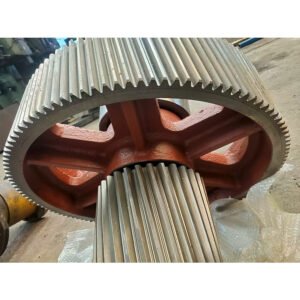
| Spur Gear | High efficiency, multi-stage needed for big reduction | Conveyor, simple gearbox |
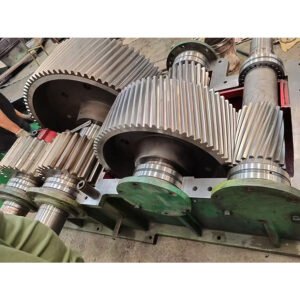
| Helical Gear | Higher efficiency, suitable for continuous heavy load | Mining main drive |
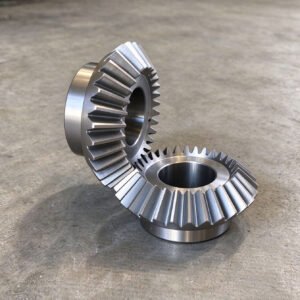
| Bevel Gear | Right-angle drive without ultra-large reduction ratio | Corner power transfer |
FAQ
Q: Worm gear vs spur gear, what is the advantage?
A: Compared to spur gear, worm gear gets a large reduction in one stage and the self-locking feature.
Q: Is worm gear efficient for long-hour heavy work?
A: Not ideal. Compared to helical gear, worm gear suffers higher friction loss and heat.
Conclusion
Our ability to process high-grade bronze alloys and hardened steels allows us to provide specialized transmission solutions for the rubber industry. These 3 sets of worm gears have been successfully integrated into the client’s curing press reducers, enhancing the safety and efficiency of their production line.