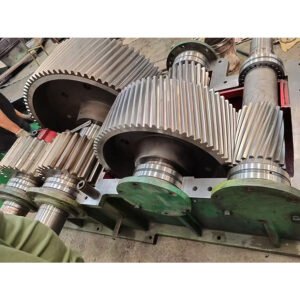
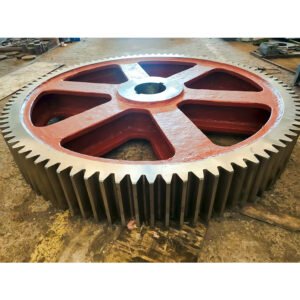
Operational downtime in tire production is often caused by the wear and tear of aging transmission components. For this project, we collaborated with a leading tire manufacturer in Qingdao to engineer high-performance replacements for their existing rubber machinery gearboxes. By replacing obsolete, worn-out gears with our custom-engineered M18 helical units, we successfully extended the equipment’s service life and optimized torque transmission.
| Gear Type | Helical Gear |
| Module | M18 |
| Material | 20CrMnTi |
| Quantity | 2 Units |
| Processing | Gear Hobbing / Gear Grinding |
| Heat Treatment | Quenching & Tempering |
| Tooth Surface Treatment | Carburizing |
| Accuracy Class | DIN 7 |
Engineering Highlights
Exceptional Load Capacity: The M18 large module design, combined with the core toughness of 20CrMnTi, allows these gears to handle the massive starting torques required in rubber processing without risk of tooth fracture.
Advanced Surface Hardening: Through a rigorous carburizing and grinding workflow, we achieved a hard-wearing surface that maintains its profile integrity far longer than standard replacement parts.
Seamless Retrofitting: Our engineers prioritized dimensional accuracy to ensure these 2 units functioned as a “drop-in” replacement, eliminating the need for complex modifications to the client’s original gearbox housing.
Our custom helical gear serves mining, marine, paper-making and rubber machinery. Compared to spur gear, helical gear offers progressive tooth engagement, higher load capacity and much quieter running, though axial thrust will occur and thrust bearings are necessary. Compared to bevel gear, helical gear is designed for parallel shaft drive and supports large-size batch & bespoke production. All helical gears can be supplied with MTC and ultrasonic test reports.
Comparison with other gear types
| Gear Type | Core Difference vs Helical Gear | Typical Application |
|---|---|---|
| Spur Gear | Cheaper, no axial thrust, noisy at high speed | Low-speed general transmission |
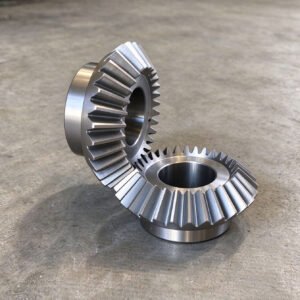
| Bevel Gear | Intersecting shaft drive, changes power direction | Corner transmission |
| Girth Gear | Ultra-large diameter, low-speed heavy load peripheral drive | Ball mill, rotary kiln |
FAQ
Q: Helical gear or spur gear, which is quieter?
A: Compared to spur gear, helical gear runs quieter thanks to gradual tooth meshing.
Q: Does helical gear create axial force?
A: Yes. Compared to spur gear, helical gear generates axial thrust that must be absorbed by bearings.
Conclusion
We specialize in reverse engineering for worn M18 gears to ensure perfect compatibility during restoration. This case highlights our ability to support the tire industry with critical spare parts and retrofitting services. By delivering these high-precision M18 gears, we empowered our client to revitalize their legacy machinery, ensuring a reliable and efficient production flow.