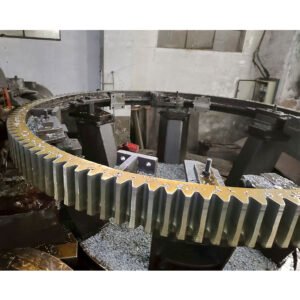
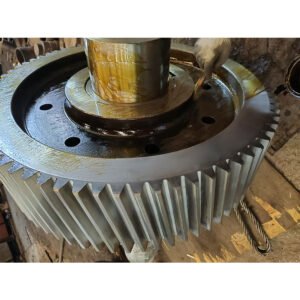
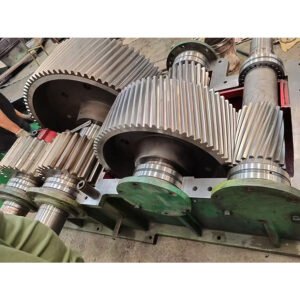
Curing presses require precise and durable transmission components to ensure consistent pressure and cycle times during rubber vulcanization. We recently fulfilled a large-scale order of 70 units of custom spur gears for a prominent rubber machinery manufacturer in Qingdao. These industrial gears are designed to optimize the performance and reliability of heavy-duty industrial curing systems.
| Gear Type | Spur Gear |
| Module | M10 / M14 |
| Material | 40Cr |
| Quantity | 70 Units |
| Processing | Gear Hobbing |
| Heat Treatment | High-temperature Normalizing |
| Tooth Surface Treatment | High-Frequency Quenching |
| Accuracy Class | DIN 8 |
Why quench and temper, then harden after cutting
40Cr at 0.40% carbon and around 1% chromium is built for quenching and tempering: the result is tempered sorbite, strong but still able to yield under a closing force instead of cracking. Normalizing would leave it too soft for a press that cycles thousands of times a shift. The flanks are induction hardened afterwards, and because DIN 8 leaves a tolerance band wide enough to absorb the distortion that comes with it, no grinding step is needed at this grade. Move the same part to DIN 7 and the sequence stops working.
The Engineering Advantage
Balanced Durability: By utilizing 40Cr combined with targeted high-temperature normalizing, our gears achieve an ideal balance between refined internal grain structure and excellent overall mechanical toughness.
Cost-Effective Precision: Our gear hobbing process combined with DIN 8 accuracy ensures that the gears operate smoothly within the curing press assembly, reducing maintenance needs without high costs.
Scalable Batch Production: Delivering 70 units within a short timeframe (Jan-Apr 2026) demonstrates our capacity to support large-scale OEM requirements for rubber machinery production lines.
Seventy pieces is a consistency problem, not a precision problem: Getting one gear to DIN 8 is routine; getting the seventieth to match the first is not. Hob cutter wear drifts tooth thickness across a run, so cutters are checked and indexed on a schedule rather than at failure, and the first and last parts of a batch are measured against the same base. Tempering in batches adds a second variable — furnace position — which is why hardness is checked per load, not per order.
Conclusion
This project highlights our ability to deliver high-quality, standardized transmission solutions for the rubber industry. These 70 units of spur gears have been successfully integrated into our client’s latest curing press series, ensuring stable and efficient operation for end-users.
FAQ
Q: Can you repeat the same gear later as a spare parts order?
A: Yes — the tooth data stays on file, so a repeat order does not need a new drawing.
Q: Which module do curing presses usually take?
A: M10 and M14 cover most of the presses we build for; the choice follows the closing force.