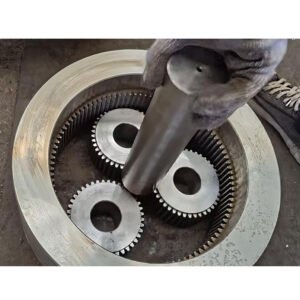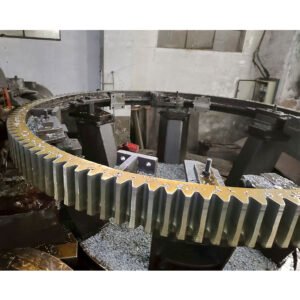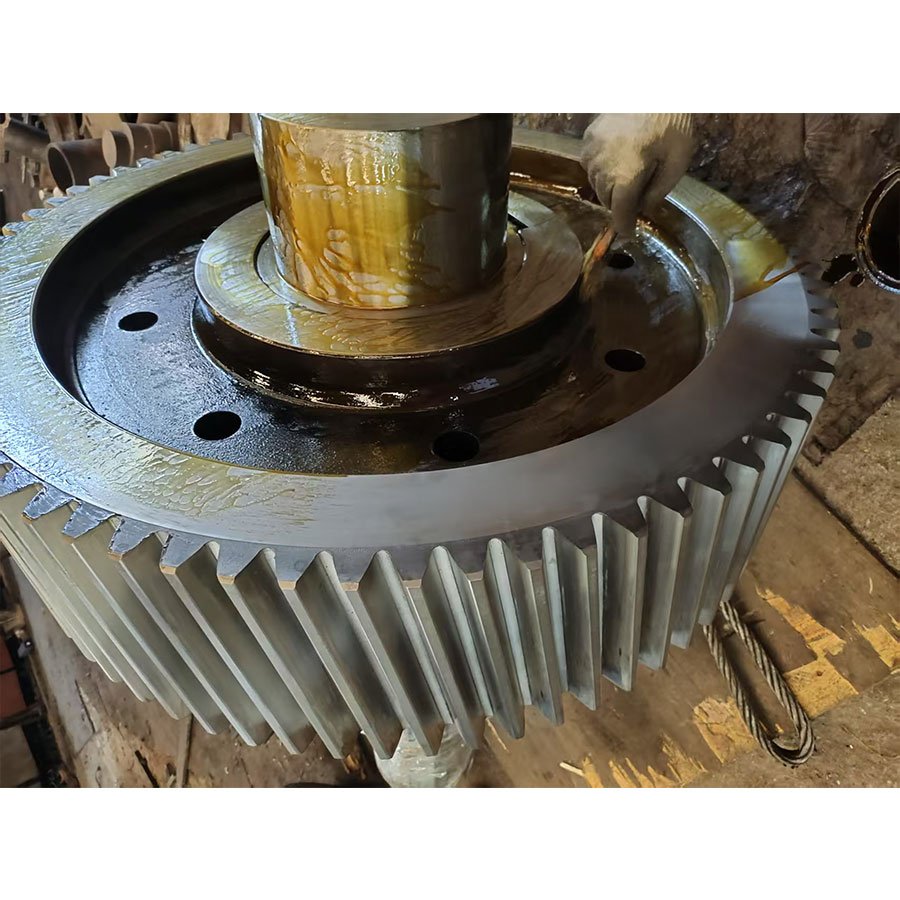
In the tire manufacturing industry, equipment uptime is critical. We recently completed a precision engineering project for a well-known tire company in Qingdao, involving the replacement of worn-out components in their rubber internal mixer gearboxes. By delivering 5 units of high-performance helical gears, we helped our client restore their production line to peak efficiency and prevent costly unplanned downtime.
| Gear Type | Helical Gear |
| Module | M14 |
| Material | 20CrMnTi |
| Quantity | 5 Units |
| Processing | Gear Hobbing / Gear Grinding |
| Heat Treatment | Quenching & Tempering |
| Tooth Surface Treatment | Carburizing |
| Accuracy Class | DIN 7 |
What fails first in an internal mixer gearbox is rarely the shaft or the bearings — it is the flank of the high-torque gear in the final reduction stage, where the same few teeth carry the full mixing load batch after batch and the case begins to pit long before the core shows distress. On a mixer built in the 1990s the housing is sound, the drawings are gone and the OEM no longer stocks the part, so a measured replacement is the only realistic route.
The Solution – Precision Retrofitting:
Seamless Integration: These gears were custom-manufactured to match the exact specifications of the original equipment, ensuring a perfect fit and seamless integration into the existing internal mixer gearbox. Tooth count was held to the original value, so the reduction stays where the mixer was designed to run; if you are reworking an obsolete unit, our note on how to calculate gear ratio shows how a single tooth change shifts output speed and the friction ratio between the rotors.
Enhanced Service Life: By upgrading to 20CrMnTi with advanced carburizing, grinding and quenching & tempering processes, the new gears offer significantly higher wear resistance compared to standard replacements, effectively extending the maintenance cycle.
Precision Engineering: Reaching DIN 7 accuracy through master-class grinding, we reduced the mechanical noise and vibration often found in older machinery, improving the overall stability of the extrusion/mixing process. Part of that comes from the tooth form itself: helical teeth enter the mesh gradually and share load across more than one pair at a time, which our high speed gearing guide sets out in terms of helix angle and overlap.
Verification Before Shipment: Each gear is checked against the measured original rather than a nominal drawing: profile and lead on the grinding machine, base pitch and backlash as a matched set. Material certificates for the 20CrMnTi billet ship with the batch, and ultrasonic inspection can be arranged on request.
Conclusion:
This project demonstrates our expertise in providing high-quality replacement and retrofitting solutions for the tire industry. Our ability to manufacture large-module (M14) precision gears allowed our client to successfully modernize their old equipment with minimal disruption to their operations.
FAQ
Q: Can you make a replacement gear when the original drawing is lost?
A: Yes — send the worn gear; we measure module, tooth count, pressure angle, helix angle, and bore, then build the drawing before machining.
Q: How long does a five-piece batch take?
A: Typically 20–40 days, including carburizing and grinding.