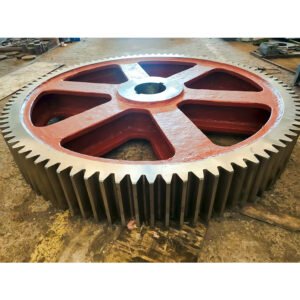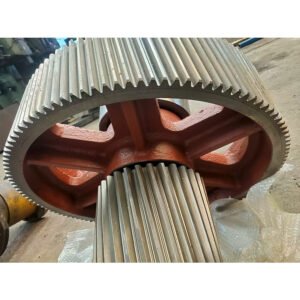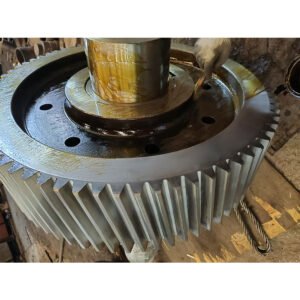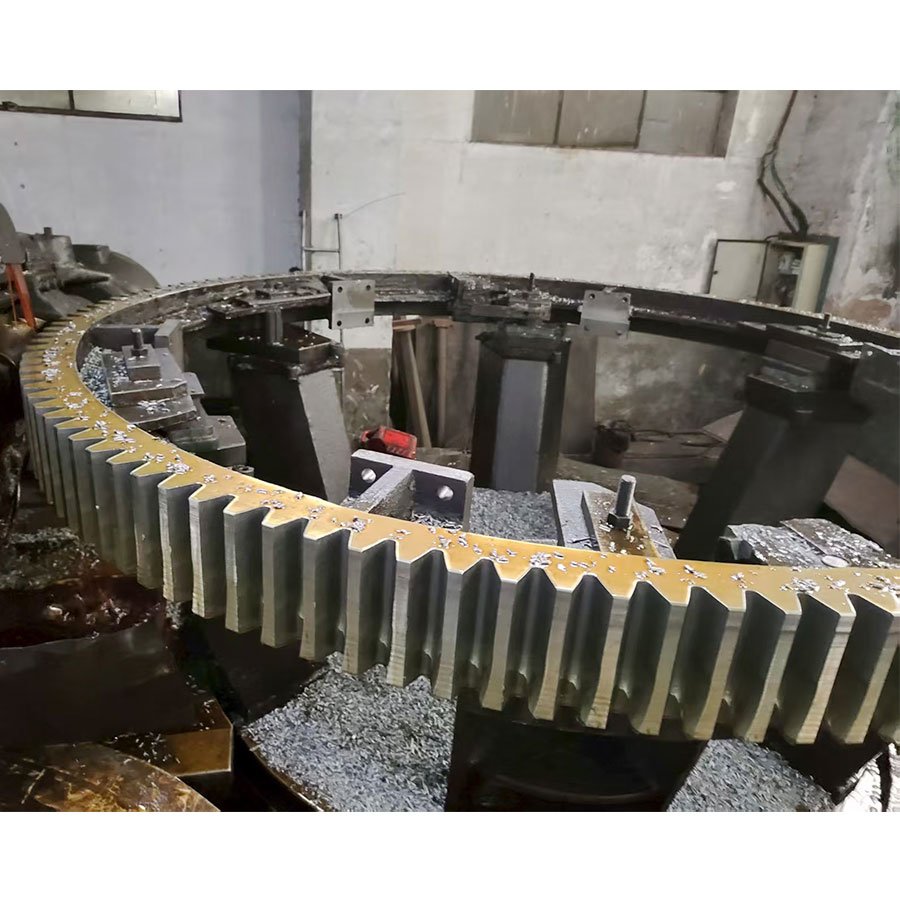
Environmental pyrolysis equipment requires robust transmission components capable of handling high torque and continuous operation in demanding waste-to-energy environments. We recently completed the manufacturing of 5 units of large spur girth gears specifically designed for pyrolysis reactors, ensuring stable power transmission for sustainable recycling processes.
| Gear Type | Girth Gear / Spur Gear |
| Module | M18 |
| Material | ZG310-570 |
| Quantity | 5 Units |
| Processing | Gear Hobbing |
| Heat Treatment | High-temperature Normalizing |
| Tooth Surface Treatment | High-Frequency Quenching |
| Accuracy Class | DIN 8 |
The Engineering Advantage
Heavy-Duty Cast Steel (ZG310-570): The choice of ZG310-570 provides the excellent mechanical properties needed to support the massive rotating components of pyrolysis equipment.
Precision M18 Tooth Profile: Our specialized gear hobbing capabilities allow us to manufacture large module (M18) teeth with the precision required to reduce friction and improve energy efficiency.
Enhanced Internal Structure: Through high-temperature normalizing, the gear achieves refined grain and uniform microstructure, improving overall strength and toughness for stable performance and longer service life.
Our custom large girth gear is core peripheral drive part for ball mills, rotary kilns and dryers. Compared to helical gear, girth gear is built for ultra-large diameter, low-speed and extremely heavy rotary loads instead of high-speed gearbox use. Compared to bevel gear, girth gear transmits torque around the outer circumference of rotating drums, not intersecting shafts. We provide girth gears with full UT, MTC and dimensional inspection reports.
Comparison with other gear types
| Gear Type | Core Difference vs Girth Gear | Typical Application |
|---|---|---|
| Helical Gear | Smaller size, high-speed gearbox parallel drive | Marine gearbox, paper machine drive |
| Spur Gear | Simple, low-cost, small & medium transmission | Auxiliary conveyor drive |
| Bevel Gear | Right-angle intersecting shaft drive | Auxiliary corner transmission |
FAQ
Q: Girth gear vs helical gear, what is the difference in usage?
A: Compared to helical gear for high-speed gearboxes, girth gear is specially designed for low-speed heavy rotary equipment like ball mills.
Q: Can girth gear replace bevel gear for 90° drive?
A: No. Compared to bevel gear, girth gear cannot change power direction, it works for peripheral drive only.
Conclusion
By delivering these 5 units of high-precision, large-module spur gears, we have helped our client enhance the reliability of their environmental equipment. This project underscores our commitment to supporting the renewable energy and waste recycling sectors with high-performance gear solutions.