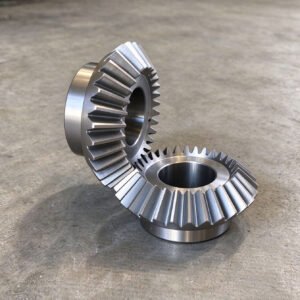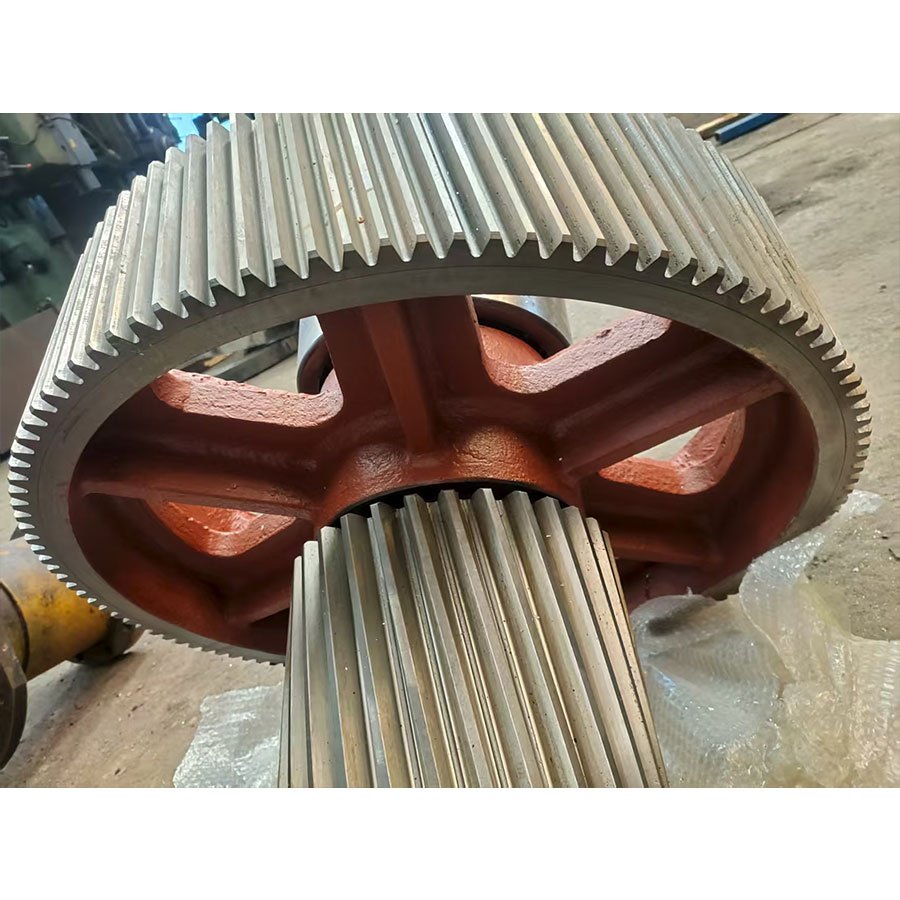
Extruder drives run at one speed for hours and never fully unload. The gears inside the extruder gearbox see continuous torque, a screw thrust that pushes back along the shaft, and a melt pressure that has to stay flat if the product is to stay on dimension. We built three sets of M16 helical gears in 42CrMo for a tire factory in Qingdao, replacing worn originals with units held to DIN 7.
| Gear Type | Helical Gear |
| Module | M16 |
| Material | 42Crmo |
| Quantity | 3 Units |
| Processing | Gear Hobbing / Gear Grinding |
| Heat Treatment | Quenching & Tempering |
| Tooth Surface Treatment | Carburizing |
| Accuracy Class | DIN 7 |
Helical was the right tooth form here. More than one pair of teeth is in contact at any moment, so the mesh runs quieter and carries more torque per unit of face width than a spur pair of the same size — which matters on a drive that never stops. The price is axial thrust, and an extruder gearbox already carries thrust bearings for the screw, so the helix adds nothing the housing was not built for.
42CrMo at roughly 0.42% carbon cannot be carburized; there is no low-carbon skin for carbon to diffuse into. The route for this grade is quench and temper through the whole section, which brings the tooth to a strong, uniform tempered structure, then induction hardening on the flanks alone. The surface reaches a hardness that resists pitting and abrasive fillers; the core stays strong enough that a shock from a cold start does not crack a tooth.
DIN 7 is where the accuracy grade earns its money. Cumulative pitch error turns into transmission error — the output shaft runs slightly fast and slightly slow within each revolution — and that ripple reaches the screw as a pressure oscillation in the melt, which shows up as wall thickness variation on a profile or sheet line. Grinding after hardening is how the grade is held: the flanks are corrected after the furnace has moved them, instead of relying on quench distortion staying small.
A three-set order is normal for this kind of work. The cost sits in measuring the worn parts and setting up the cut, not in the steel, so a small run prices out close to a large one per unit until the tooling amortises. Material certificates travel with the batch, and profile and dimensional reports can be issued if the maintenance file needs them.
FAQ
Q: Can you supply a single gear rather than a full set?
A: Yes, though a wheel is normally ordered with its mate — the contact pattern depends on both members.
Q: Can you work from a worn sample instead of a drawing?
A: Yes. Tooth count, module, helix angle and bore are measured from the part, then drawn up before cutting.
Three sets, one gearbox, back in service. The point of grinding to DIN 7 rather than cutting to a commercial grade is that the drive keeps its accuracy after the repair instead of trading one vibration source for another.