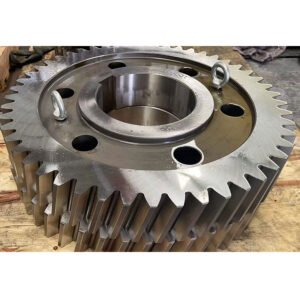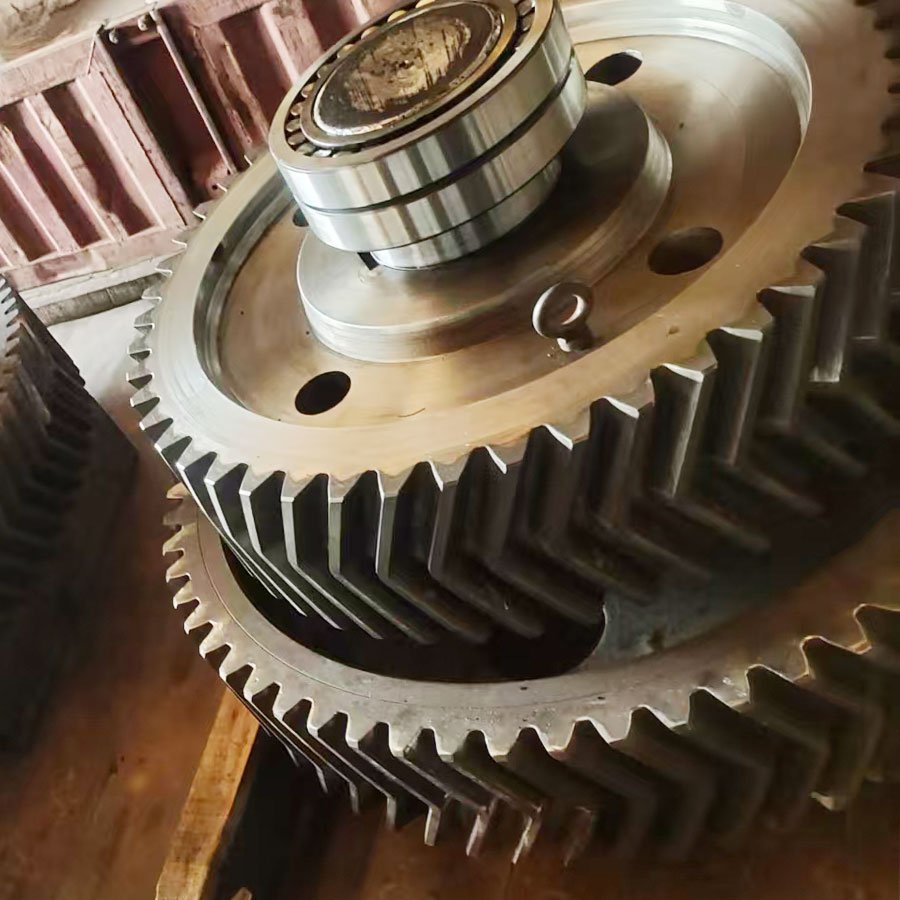
Marine dredging operations demand extraordinary mechanical reliability under high-torque conditions. We recently completed a specialized project for a marine dredging company, delivering 7 units of large-module herringbone gears. These “double helical” components are the preferred choice for marine gearboxes due to their unique ability to neutralize axial thrust while providing smooth, high-capacity power transmission.
| Gear Type | Herringbone Gear |
| Module | M16 |
| Material | 40Cr Alloy Steel |
| Quantity | 7 Units |
| Processing | Gear Hobbing / Gear Grinding |
| Heat Treatment | Quenching & Tempering |
| Tooth Surface Treatment | High-Frequency Quenching |
| Accuracy Class | DIN 7 |
Why the centre apex costs money
A herringbone gear is two helices of opposite hand joined at the middle, and that joint is where the cost sits. The apex blocks a grinding wheel from running straight through, so the two halves have to be ground from opposite ends and blended to a common tooth thickness — a step two separate helical gears never need. What you buy with that cost is a bearing arrangement with no axial load to carry: on a short marine housing, removing that thrust bearing is usually worth more than the extra machining.
The Engineering Advantage
Superior Axial Load Management: The herringbone design inherently cancels out the axial thrust that typically plagues single helical gears. This ensures the stability of the gearbox bearings and extends the overall life of the dredging equipment. It also explains why double helical stages sit where they do in a marine reduction train: a comparison of the main types of gear box shows when a herringbone stage earns its place and when a planetary or single helical arrangement is the better fit.
Large Module Durability (M16): Engineered with an M16 module, these gears are built to handle the immense torque required by dredger pumps and propulsion systems operating in challenging offshore conditions. Module sets tooth size; output speed comes from the ratio instead. Our explainer on what is gear ratio covers how the tooth counts of the two members translate into pump speed for a given engine rpm.
Marine-Grade Resistance: By utilizing 40Cr alloy steel combined with high-frequency quenching, our gears achieve the surface integrity needed to resist pitting and wear caused by the constant loads of dredging cycles.
Where the gear sits in the dredger
These gears run in the drive train behind the dredge pump and the ladder winch, where the load is cyclic rather than steady — a cutter head biting rock loads the tooth, releases, and loads it again. On an M16 section, through-hardening would leave core and case at similar hardness and invite distortion in the furnace. Quenching and tempering first, then high-frequency quenching on the flanks only, keeps the tooth straight and puts the wear resistance where the contact actually happens.
Conclusion
This project underscores our capability in manufacturing complex, large-scale double helical gears. By delivering these 7 precision-engineered units, we have provided our client with a robust transmission solution that enhances the operational efficiency and reliability of their dredging fleet. Replacement sets are cut to the original tooth counts for that reason, and when the nameplate is gone we work back from centre distance and measured diameters—the same sequence set out in our guide on how to find gear ratio.